


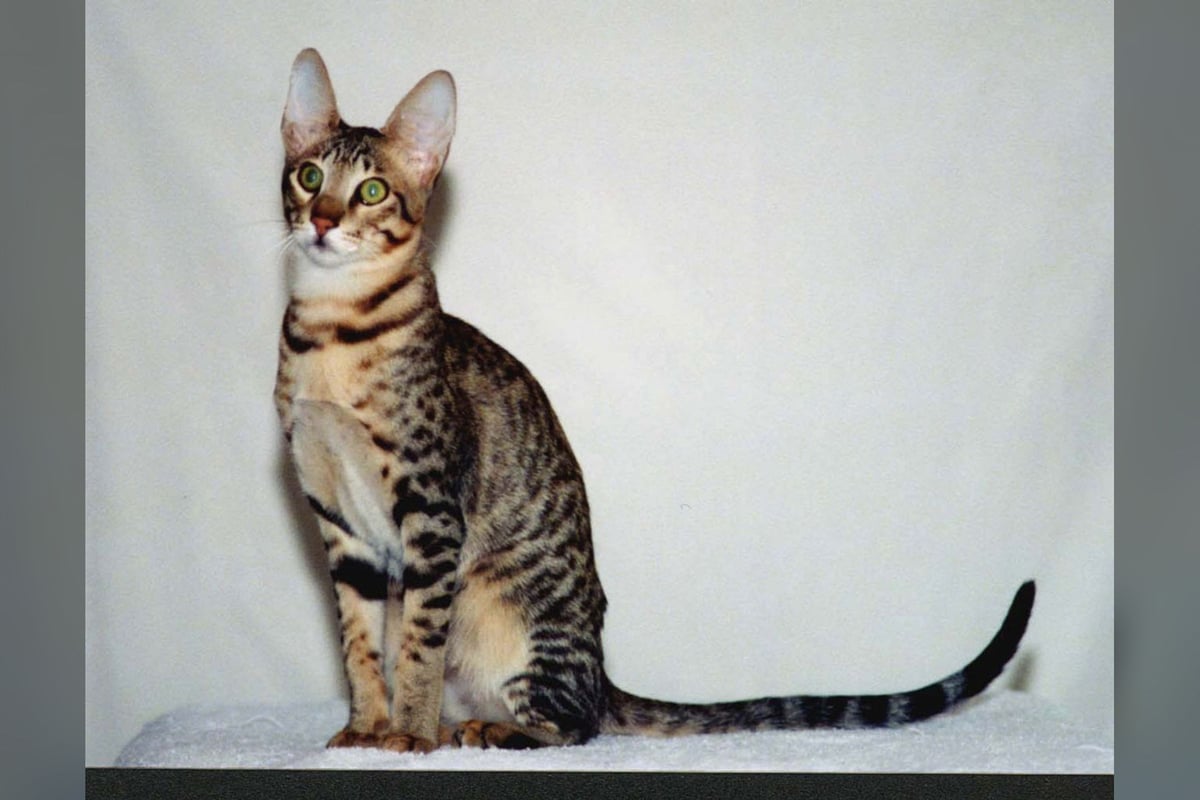
Serengeti
The Serengeti is an American breed created in 1994 by biologist Karen Sausman from Bengal × Oriental Shorthair crosses. The goal was to reproduce the look of the African Serval — slender body, tall legs, large ears, spotted coat — without introducing direct wild blood into the pedigree. Recognized by TICA since 2004, it remains extremely rare in France and in most European countries.
- Weight
- 4 to 7kg
- Height
- 28 to 38cm
- Life expectancy
- 14years
- Monthly cost
- 70 to 130€
Personality profile
Energy 5/5
Independence 2/5
Trainability 4/5
Good with children 4/5
Talkativeness 3/5
Space needed 4/5
Attachment to home 4/5
Good with strangers 3/5
Good with cats 3/5
Good with dogs 3/5
Coat care 1/5
Exercise needs 5/5
Scores given on measured axes, data confidence: medium.
Living with a Serengeti
Description
Large-format with an elongated oriental body, carried high on fine, muscular legs that rank among the longest of any domestic breed. The silhouette is that of a sprinter: narrow flanks, hips slightly higher than the shoulders, a long muscular neck. Weight generally falls between 4 and 7 kg, with marked sexual dimorphism — males regularly exceed 6 kg while females stay between 4 and 5 kg. The head is moderate in size, round but never cobby, with a broad forehead and high cheekbones. The muzzle is short, without a pronounced stop. The most striking feature remains the ears: very large, wide at the base, upright and well spaced on the skull, directly recalling those of the Serval. The eyes are large, round or slightly oval, gold, copper or hazel in color — green and blue are excluded from the TICA standard. The coat is short, dense, slightly satiny to the touch, in a texture close to that of the Bengal. The standard pattern is spotted (spotted tabby): round or slightly oval spots, well defined, on a golden, fawn or ochre background — the spots must be black or dark brown, clearly separated from one another. The silver variant also exists: a silvery or off-white background with black spots, giving a sharp contrast reminiscent of the grey Serval. The Bengal's rosettes are not part of the standard — the spots must remain simple. The legs and tail carry rings.

Temperament
Extremely active, curious and sociable, it barely tolerates passivity. Its energy level is notably higher than the average domestic breed — comparable to the Bengal or the Savannah — and calls for an environment that channels it: tall cat trees, exercise wheels, daily interactive hunting games. Unlike some energetic breeds that stay aloof, this one is deeply attached to its humans. It follows its owners from room to room, joins in household activities, and is not the type to isolate itself. Its vocalization is moderate — it communicates readily but without the insistence of the Siamese. Its intelligence is real: it quickly learns household routines, can memorize object-sound associations, and gets bored easily if the cognitive environment is poor. Cohabitation with well-socialized cats is generally positive, provided the companion can keep up with its pace — it is not suited to elderly or very sedentary cats. With active, respectful children, its playful temperament and physical robustness work well.
Training
Few breeds are as receptive to active training. Its intelligence, inherited in part from the Bengal and the Oriental Shorthair, combined with its strong desire to interact with its humans, makes it an excellent candidate for clicker training. It can learn to respond to its name, perform simple behaviors (sit, paw, target jumping), and accept a harness for leash outings — provided it is exposed to the harness early, ideally before 4 months. Sessions should be short (5 to 10 minutes maximum), frequent, and end on a success to maintain motivation. Its high energy level can make it hard to focus for long periods: splitting sessions into two calm moments of the day gives better results. Punishment is counterproductive — this breed responds exclusively to positive reinforcement.

Feeding
Muscular and very active, it has energy needs clearly higher than those of an average sedentary cat. A premium diet rich in animal protein (minimum 40%) is recommended, with a fat content matched to its activity level. For a very active 5-6 kg adult, needs can reach 280 to 320 kcal/day — significantly more than a calm breed of the same size. Two measured meals a day are preferable to free feeding; neutering reduces needs by 20 to 30% without suppressing appetite. A partial wet ration (50 to 70%) is advised for hydration, particularly to help prevent kidney disease, which can occur in aging cats of slender build. Taurine and arginine should feature prominently in the composition — essential to the cardiac and muscular health of a very active breed. Watch the weight from age 3: a very active cat that slows down with age can gain weight quickly if the ration is not adjusted.
Affiliate links, no extra cost to you. Legal notice

Living conditions
A cramped apartment without serious enrichment is not suitable. Its size, long legs and very high energy require substantial vertical space — several climbing levels, ideally an exercise wheel or access to a secure outdoor enclosure. A house with an enclosed garden is the ideal setup. Free outdoor access is not recommended for this very rare breed: beyond the usual risks, the cost of an individual and the difficulty of finding a replacement make any accident a hard loss to offset. It tolerates heat well, its slender build favoring heat dissipation, but copes poorly with prolonged cold. A home where it would be left alone more than eight hours a day without stimulation or a companion is inadvisable without compensating arrangements.

Grooming and coat care
The short, dense coat is remarkably easy to maintain. A weekly brushing with a rubber grooming glove or a soft brush is enough to remove dead hair and keep the coat's shine. Seasonal shedding is moderate — twice a year, brushing two to three times a week for three to four weeks limits the buildup. No regular bathing is necessary. The large ears, characteristic of the breed, deserve particular attention: their size favors the buildup of earwax and, in some environments, dust. Gentle cleaning with a lightly dampened cotton pad every two weeks is recommended. The eyes should be checked periodically, although the head's unexaggerated shape does not generate chronic tearing. Claws should be trimmed every two to three weeks; weekly dental hygiene.

Health
A young, small-population breed, it does not lend itself well to robust epidemiological statistics. No breed-specific genetic disease has been formally documented and associated with the breed in the scientific literature to date. This does not mean an absence of risk, but rather reflects the lack of data on a small population. Its two founding breeds each contribute hereditary predispositions worth watching. The Bengal is affected by progressive retinal atrophy (PRA-b, CEP290 mutation), an autosomal recessive disease causing progressive retinal degeneration that can lead to blindness — a DNA test is available from specialized laboratories (Langford Vets, UC Davis). The Bengal is also associated with hypertrophic cardiomyopathy (HCM), without a mutation identified as clearly as in the Maine Coon or Ragdoll, but with an observed prevalence in breeding lines. The Oriental Shorthair, the second founding parent, shows a predisposition to hepatic amyloidosis in certain lines, as well as to dental problems linked to the narrow, elongated head shape. A serious buyer should ask the breeder for the breeding cats' PRA-b DNA test results, as well as a recent HCM cardiac echo certificate. Given the breed's rarity, the worldwide gene pool remains narrow: this structural fragility is a long-term risk factor that breeders must actively manage through controlled outcrossing.
Breed history
The Serengeti was born in 1994 at Kingsmark Cattery (California), a program run by Karen Sausman, a biologist at the Palm Springs Desert Museum. Her stated goal was to create a domestic breed morphologically evoking the African Serval (Leptailurus serval) — large ears, slender body, tall legs, spotted coat — without resorting to crosses with wild felines, unlike the Savannah, which directly uses the F1 Serval. To achieve this, Sausman crossed Bengals (which already carried the spotted look derived from the Asian leopard cat hybridized by Jean Mill since the 1960s) with Oriental Shorthairs (which contribute the long body, tall legs and large ears). The breed was submitted to TICA for evaluation as early as 1994, obtained developing-breed status (Preliminary New Breed) and then progressed to Advanced New Breed. It is recognized by neither FIFe, nor LOOF, nor the CFA or WCF — its recognition therefore remains exclusively TICA to date. The worldwide population remains very limited: nearly all active breeders are located in the United States, with a few programs in Australia and Northern Europe. In France, numbers are anecdotal — a few catteries occasionally import individuals, but no structured breeding program is documented on a large scale.
Getting ready for your Serengeti
Four essentials to line up before day one.
Affiliate links, no extra cost to you. Legal notice
FAQ: Serengeti
Sources
- Wikipedia EN — Serengeti cat · Breed created in 1994 by Karen Sausman (Kingsmark Cattery, California) via Bengal × Oriental Shorthair. Goal: mimic the Serval's appearance without wild blood. TICA status: Advanced New Breed. Spotted coat on a golden or silver background. Large ears, long legs, elongated oriental body.
- TICA — Serengeti Breed Introduction · Official TICA standard for the Serengeti: elongated semi-foreign body, tall legs, very large wide-based ears, round gold-to-copper eyes. Spotted tabby pattern mandatory. Colors: brown spotted tabby, silver spotted tabby. TICA recognition only.
- Wikipedia FR — Serengeti (cat) · Overview article on the Serengeti breed: 1994 creation history, Bengal-Oriental Shorthair cross, Serval-inspired morphological goal, TICA recognition. Very limited presence in Europe and France.
- The International Cat Association — Bengal Breed Article · Hereditary predispositions of the Bengal documented by TICA: PRA-b (CEP290 mutation, DNA test available), HCM. Since the Serengeti inherits from the Bengal, these predispositions should be monitored in Serengeti breeding programs.

