


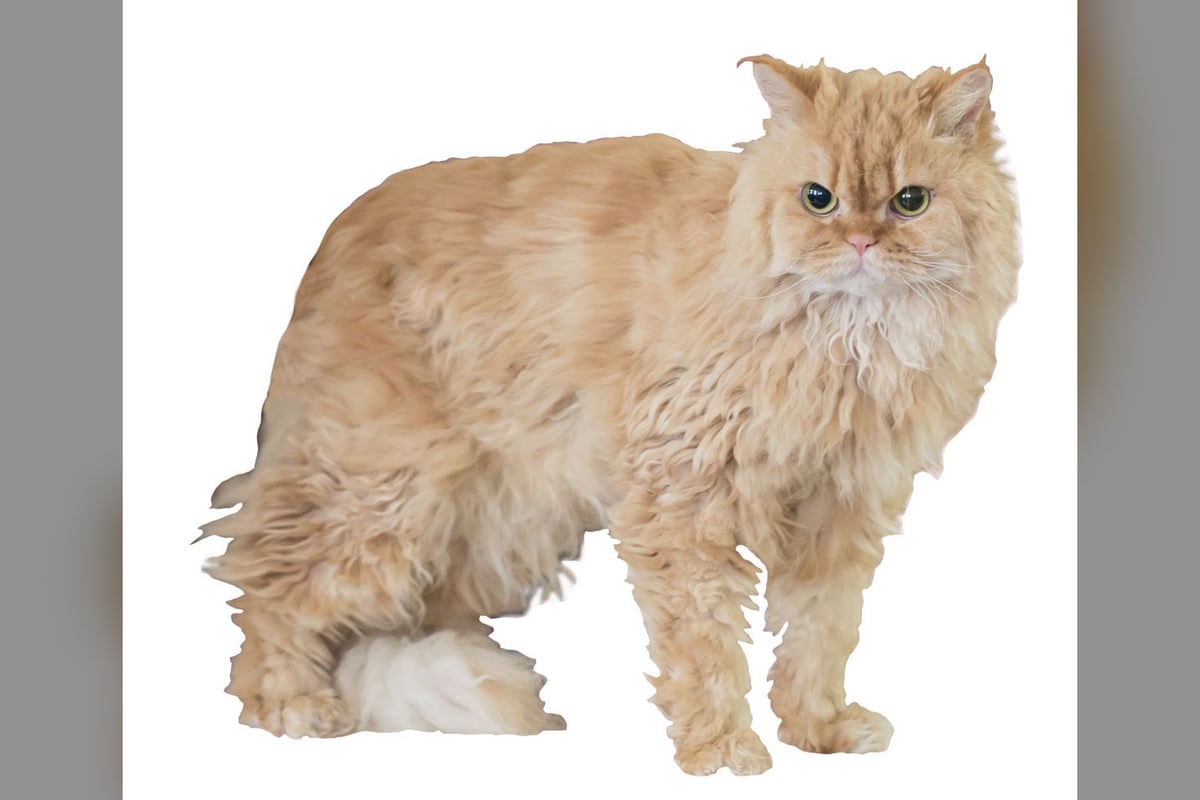
Selkirk Rex
The Selkirk Rex was born in 1987 in Montana from a spontaneous, autosomal dominant mutation, the only one in the rex world to produce a cat with a cobby, massive build. Its dense, spiral-curled coat — available in shorthair and longhair versions — is not the result of crossing rex breeds: the Selkirk's curls form distinct ringlets across all three layers of the coat, unlike the flat waves of the Cornish or Devon Rex. A calm, patient, sociable breed, it suits families as well as multi-pet households, provided you plan for regular curl maintenance and rigorous genetic screening linked to its Persian and British Shorthair ancestry.
- Weight
- 4 to 7kg
- Height
- 25 to 35cm
- Life expectancy
- 14years
- Monthly cost
- 70 to 130€
Personality profile
Energy 3/5
Independence 3/5
Trainability 3/5
Good with children 4/5
Talkativeness 2/5
Space needed 3/5
Attachment to home 4/5
Good with strangers 3/5
Good with cats 4/5
Good with dogs 4/5
Coat care 4/5
Exercise needs 2/5
Scores given on measured axes, data confidence: high.
Living with a Selkirk Rex
Description
The build is semi-cobby, massive and muscular, clearly distinct from the lean silhouettes of other rex breeds. The body is rectangular, the bone structure solid and well developed, the chest broad. The head is round and broad, with full cheeks, a square muzzle with softened contours and a slight concavity to the profile — a partial legacy of the Persian crosses. The eyes are large, round and well spaced; the ears are medium-sized. The most immediate trait is the coat: well-defined spiral curls ("ringlets") cover the whole body, more pronounced on the neck, flanks and belly. Unlike the Cornish Rex (a single coat layer) or the Devon Rex (short down), all three coat layers — guard hair, down and awn — are present here and all curled. The whiskers are also wavy and more fragile than usual. Two variants are officially recognized by the LOOF: the Selkirk Rex Shorthair (SES) with dense, well-defined curls, and the Selkirk Rex Longhair (SEL) with looser, silkier waves. Every color and pattern is admitted. Males generally weigh 5 to 7 kg; females 4 to 5.5 kg. Life expectancy: 13 to 15 years.

Temperament
It's often described as a blend of its parent breeds' qualities: the British Shorthair's serenity and reserve, the Persian's deep affection, and the Exotic Shorthair's playful streak. The result is a fundamentally balanced cat — neither hyperactive nor distant. It seeks human contact without demanding it obsessively, settles readily on laps or near its owners, and copes reasonably well with daytime absences provided the environment is enriched. Its patience is remarkable: it tolerates without reacting children who approach and other animals that explore it. It cohabits without difficulty with other cats or with properly introduced dogs. Its vocalizing is discreet — it communicates through presence rather than meowing — and it is never insistent. Its playful side persists beyond kittenhood, without reaching the intensity of Oriental breeds. Given attention and stimulation, it shows remarkable steadiness.
Training
Receptive to learning, it's still not the most enthusiastic of feline learners. Its calm intelligence and motivation through food rewards make it accessible to basic clicker training: answering to its name, accepting carrier transport, and tolerating brushing and veterinary care are the priority goals. Short 5-to-8-minute sessions, repeated regularly, give the best results. Its natural patience means it doesn't react negatively to handling mistakes, which eases early kitten socialization. Exclusively positive reinforcement is the only suitable method — any physical restraint damages the trust it builds slowly but durably. Its taste for skill games (food puzzles, manipulation toys) is an effective learning vehicle.

Feeding
Cobby build and a natural tendency toward sedentary behavior put it at risk of overweight, particularly in neutered indoor cats. Weight management is the central nutritional concern: avoid free feeding, split into two meals a day with measured amounts. Favor a premium diet high in animal protein (minimum 35%) and moderate in carbohydrates to preserve muscle mass without encouraging fat storage. Taurine must be present in adequate amounts as preventive heart protection, given the HCM risk. Adequate hydration matters for preventing kidney disease (PKD): a wet-food component in the ration (wet food or rehydrated kibble) is recommended. After 8 years, a low-phosphorus senior formula helps preserve kidney function. Ideal adult weight falls between 4 and 7 kg depending on sex; a monthly rib-palpation check catches drift early.
Affiliate links, no extra cost to you. Legal notice

Living conditions
Apartment life suits it well: a compact build, a moderate energy level and a calm temperament don't call for large spaces. A standard-sized apartment with a few climbing surfaces and window access is enough for its balance. It's not a compulsive hunter or a determined climber, but it enjoys interactive toys and regular play sessions to keep up muscle tone and prevent weight gain. Its cobby build and dense coat give it reasonable tolerance for temperature swings, without being immune to extremes — avoid rooms that are too hot and humid, which can soften the curls and cause skin problems. Indoor living is strongly recommended, particularly to protect the structure of the curled whiskers, more fragile than usual and vulnerable to friction. Daily 10-to-15-minute play sessions are enough to keep it balanced.

Grooming and coat care
Caring for the curly coat is counterintuitive: brushing too often or too vigorously destroys the ringlets and turns the coat into an undefined cottony mass. The rule is to work with the curls, not against them. In Shorthair, a pass with a wide, spaced-tooth comb (an "afro" style comb or a wide-spaced cat comb) once or twice a week is enough to remove dead hair without undoing the spirals. In Longhair, frequency can rise to twice a week during the seasonal molts (spring and fall), starting with the areas most prone to tangling: behind the ears, under the armpits and at the base of the tail. A monthly bath with a gentle, silicone-free shampoo reactivates the curls after air-drying or cool-setting blow-drying. Avoid pin brushes or slicker brushes, which air out the fur but break the spirals. Clean the ears every two weeks; check the eyes regularly given the partially brachycephalic head shape of some cats.

Health
Three conditions dominate health monitoring. Polycystic kidney disease (PKD1) is the most critical risk, directly inherited from historical crosses with the Persian and the Exotic Shorthair: the autosomal dominant PKD1 mutation causes the progressive formation of kidney cysts leading to kidney failure. The PKD1 DNA test is mandatory on both breeding parents — a positive result in either one is enough to exclude the animal from breeding. Hypertrophic cardiomyopathy (HCM) is also documented in the breed; regular echocardiograms of breeding cats remain recommended even in the absence of a validated DNA test for the breed. Hip dysplasia, inherited from British Shorthair lines, can affect long-term mobility and warrants radiographic monitoring in cats showing signs of stiffness. A blood type incompatibility (neonatal isoerythrolysis) has been reported in crosses between type A and type B: blood typing of breeding cats is advised. Gingival hyperplasia (thickened gums) is a minor predisposition documented in certain lines. The breed is not hypoallergenic.
Breed history
It all began on July 4, 1987 in the Sweetgrass Hills of Montana, when a shelter cat gave birth to a litter in which one kitten had wavy whiskers and a dense curly coat. The queen was entrusted to Persian breeder Jeri Newman, who gave her the show name "Miss DePesto of NoFace" — a reference to the character from the TV series Moonlighting and to her cattery's suffix. Newman crossed Miss DePesto with her black Persian, Photo Finish of Dekay: the litter produced three curly kittens and three straight-coated ones, confirming the autosomal dominant nature of the mutation. Unlike the recessive mutations of the Devon Rex and the Cornish Rex, the Selkirk's (the Se gene) is dominant and affects all three coat layers. Newman named the breed after her stepfather — a first in feline history, where a breed carries the name of a living person. Recognized by TICA in 1992 and then by the CFA in 2000 (championship status), the breed benefited for decades from approved outcrosses with the Persian, the Exotic Shorthair and the British Shorthair to build up numbers and fix the cobby build. The CFA definitively closed these outcrosses in January 2025; the LOOF recognizes the breed in both the Shorthair (SES) and Longhair (SEL) variants, every color admitted.
Getting ready for your Selkirk Rex
Four essentials to line up before day one.
Affiliate links, no extra cost to you. Legal notice
FAQ: Selkirk Rex
Sources
- Wikipedia FR — Selkirk Rex · Origin: Montana 1987, founding queen Miss DePesto of NoFace. Autosomal dominant mutation (Se gene), three curled coat layers. Recognized by TICA 1992, CFA 2000, FIFé 2018. Shorthair and longhair variants.
- LOOF — Selkirk Rex (SES / SEL) · Breed recognized in two variants (SES Shorthair, SEL Longhair). Semi-cobby, massive, muscular body. Every color and pattern admitted. Grooming monthly (SH) to weekly (LH).
- Royal Canin FR — Selkirk Rex profile · Calm, tolerant, lively and balanced temperament. Combines British Shorthair, Persian and Exotic Shorthair character. Moderate upkeep recommended.
- CFA — Selkirk Rex Breed Profile · Males 12-15 lb (5.4-6.8 kg). Outcrosses: Persian (before 2020), British Shorthair/Exotic (before 2025), Selkirk × Selkirk only since Jan. 2025. Recommended tests: PKD, HCM, hip dysplasia, blood typing.

