


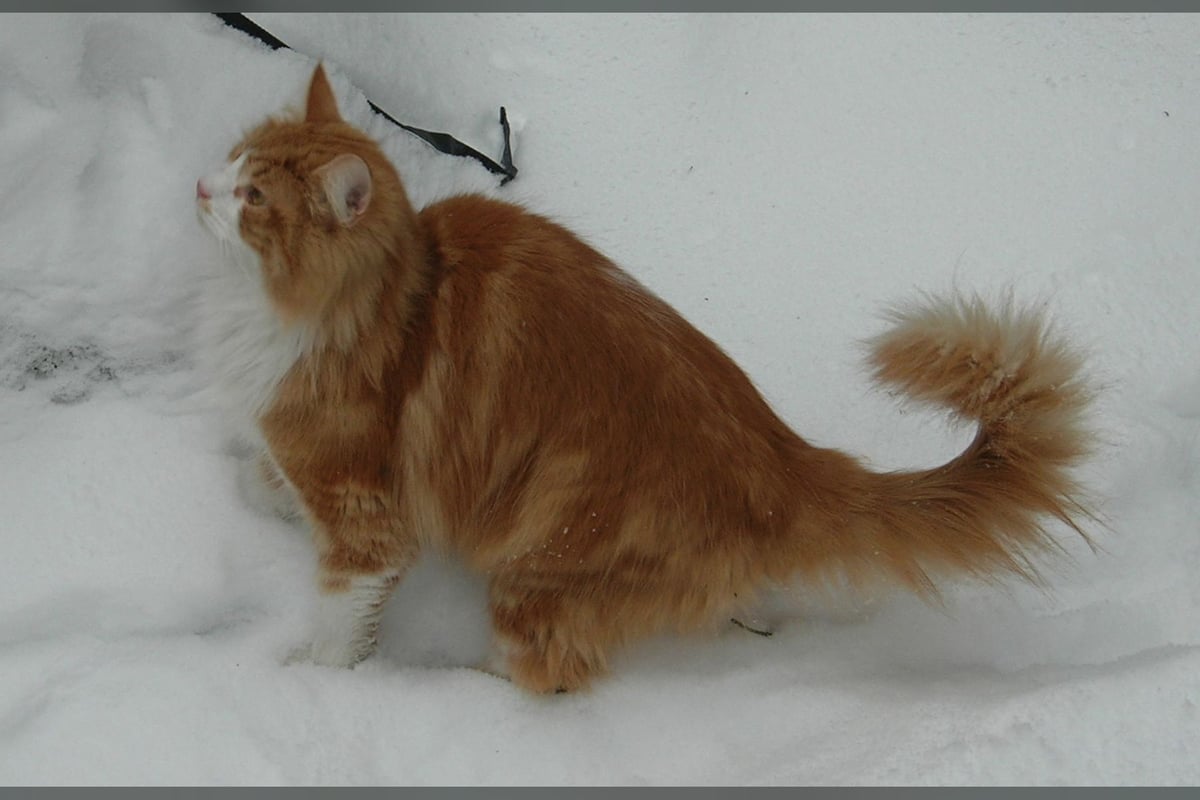
Norwegian Forest Cat
The Norwegian Forest Cat, or "Skogkatt" in its native language, is the official national breed of Norway: a large, semi-wild cat adapted to harsh Nordic climates, with a waterproof double coat and an athletic build. Recognized by the LOOF in the 1970s, it ranks among the top 10 most-registered breeds in France, with around 3 500 annual registrations, trailing the Maine Coon among large semi-longhaired cats.
- Weight
- 3.5 to 9kg
- Height
- 28 to 40cm
- Life expectancy
- 15years
- Monthly cost
- 65 to 110€
Personality profile
Energy 4/5
Independence 4/5
Trainability 3/5
Good with children 5/5
Talkativeness 2/5
Space needed 4/5
Attachment to home 4/5
Good with strangers 3/5
Good with cats 4/5
Good with dogs 4/5
Coat care 4/5
Exercise needs 4/5
Scores given on measured axes, data confidence: high.
Living with a Norwegian Forest Cat
Description
The silhouette is powerful, fitting within a triangle, with an equilateral triangular head, a straight nose (with no marked stop, unlike the Maine Coon), and ears set high and wide at the base, adorned with tufts and lynx tips. The coat is the most characteristic element: a waterproof double layer, with a dense woolly undercoat and a longer, glossy outer coat. A marked ruff frames the face in winter, along with developed britches and an extremely bushy tail that often exceeds the length of the body. The hind legs are longer than the front, the signature of expert climbers. Physical maturity is slow: the breed reaches its full adult size only between 4 and 5 years old. Males 5-9 kg, females 3.5-6 kg. All coat colors admitted except colorpoint, chocolate, lilac, cinnamon and fawn. Life expectancy 14-16 years.

Temperament
It combines native independence with a deep attachment to its household. More reserved than the Maine Coon on first meeting, it observes newcomers before engaging — a trait that makes it an excellent cat for people who like company without constant dependence. It is sociable with its close family, follows its owners without clinging, and enjoys climbing games and simulated hunting. Its vocalizing is discreet but expressive: it purrs abundantly and emits characteristic trills to communicate. Curious and playful well into old age, it retains a touch of "feral" behavior that makes it particularly interesting to watch. It cohabits well with children, other cats and sociable dogs provided the introduction is gradual.
Training
Intelligent and cooperative, it is less demanding of active training than a Bengal or an Abyssinian. Clicker training works well on agility exercises (obstacle courses, directed jumps) that channel its high exercise needs. Motivation comes through play as much as treats. The harness is generally well accepted with gradual introduction from kittenhood — useful for balcony outings or a secure garden. No physical restraint should be used: the breed feels coercion strongly and shuts down for a long time. Sessions should stay short (5-10 minutes), positive, and spontaneous climbing and simulated-hunting activity is just as formative as structured training.

Feeding
A breed with a substantial build and an active metabolism, it needs sustained calorie intake, particularly during the slow growth phase (up to 4-5 years). For an active 6 kg adult, plan for 280-340 kcal/day depending on activity level (more with winter outdoor access). Favor large-breed-specific kibble rich in animal protein (≥38%) and taurine (cardiac support, HCM prevention). For kittens up to 15 months, large-breed kitten kibble with a balanced calcium/phosphorus ratio to support bone growth. Two to three split meals a day. The breed is less prone to obesity than the British Shorthair thanks to its activity level, but monitoring remains necessary after neutering.
Affiliate links, no extra cost to you. Legal notice

Living conditions
The breed thrives fully in a house with a garden or in a large apartment (≥70 m²) fitted with substantial vertical climbing structures — a studio or one-bedroom with no usable height is not advisable. Its history as a semi-outdoor Scandinavian cat makes it one of the rare pedigree cats able to benefit from secure outdoor access without major behavioral risk. In a strict apartment setting, provide a cat tree over 2 meters tall, wall shelves, and a secure window with an outdoor view. An ideal breed for a temperate or cold climate: very cold-tolerant, it suffers strongly, on the other hand, from summer heat (above 26 °C). A cool room, ventilation and permanent access to water are essential during a heatwave.

Grooming and coat care
The double coat needs weekly brushing under normal conditions, stepped up to 3-4 times a week during intense seasonal shedding (spring above all, when the woolly winter undercoat sheds heavily). Use a wide-toothed metal comb to detangle the outer coat, then a fine-toothed comb to remove dead undercoat. The coat's waterproof structure makes it self-cleaning: a bath is rarely necessary (1-2 times a year at most) and difficult, since the coat repels water. Watch the hind britches and the base of the tail, where mats can form. The ear and toe tufts can be trimmed slightly for extra comfort.

Health
Three major genetic predispositions dominate the picture, all testable. Glycogen storage disease type IV (GSD IV) is an autosomal recessive mutation specific to the breed, fatal in homozygous kittens (neonatal death or death before 6 months). The GSD IV DNA test is imperative on both breeding parents — demand the results at purchase. Hypertrophic cardiomyopathy (HCM) also affects the breed, with no MyBPC3 mutation specific to it as in the Maine Coon; an annual echocardiogram screening from age 2 is recommended for breeding cats. Pyruvate kinase deficiency (PKDef) causes recurring hemolytic anemia — a DNA test is available. Moderate hip dysplasia is reported in around 10-15% of individuals, to be monitored by X-rays of adult breeding cats. The breed is generally robust, with a life expectancy above average (14-16 years).
Breed history
The breed appears in ancient Nordic myths: the goddess Freya is said to have driven a chariot pulled by Skogkatt, and the Vikings are said to have taken these cats aboard their longships to hunt rodents. The breed then evolved in a purely utilitarian way on Scandinavian farms for centuries, shaped by environmental pressure rather than formal breeding. It was only in the 1930s that Norwegian breeders began a preservation program to distinguish the breed from imported domestic cats that threatened its genetic heritage. World War II dramatically reduced the population; reconstruction was undertaken in the 1970s at the initiative of breeder Carl-Fredrik Nordane, who obtained FIFe recognition in 1977. King Olav V of Norway made it the official national breed in 1979. The breed arrived in France in the early 1980s and has steadily grown in LOOF registrations ever since.
Getting ready for your Norwegian Forest Cat
Four essentials to line up before day one.
Affiliate links, no extra cost to you. Legal notice
FAQ: Norwegian Forest Cat
Sources
- Wikipedia FR — Norwegian (cat breed) · Official national breed of Norway since 1979. FIFé recognition 1977 at the initiative of Carl-Fredrik Nordane. Glycogen storage disease IV specific testable mutation.
- LOOF — Recognized cat breeds · The Norwegian is among the breeds officially recognized by the Livre Officiel des Origines Félines, semi-longhair category, top 10 of French registrations.
- Royal Canin — Norwegian Profile · Life expectancy 14-16 years, maturity 4-5 years. Hardy breed adapted to cold climates, HCM predisposition and hip dysplasia to watch.
- FIFé — Norwegian Forest Cat Breed Standard · FIFé standard: equilateral triangle, waterproof double coat, longer hind legs. All coat colors admitted except chocolate/colorpoint.
Breeds similar to a Norwegian Forest Cat

