


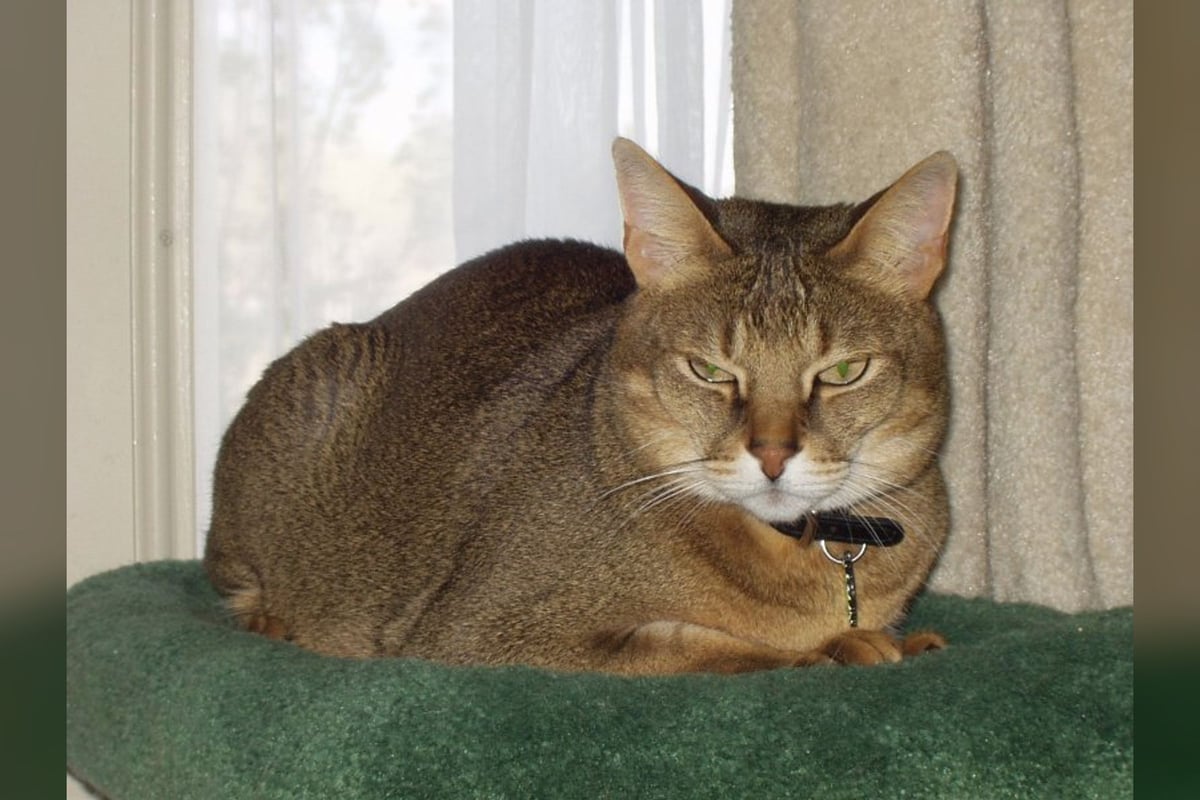
Chausie
The Chausie is a large hybrid resulting from crosses between the wild jungle cat (Felis chaus) and domestic cats, mainly Abyssinians and Orientals. Developed in the United States starting in the late 1960s and recognized at TICA championship level since 2013, it has an athletic, long-legged silhouette, a coat with characteristic ticking, and a metabolism inherited from its wild ancestor that requires a grain-free diet.
- Weight
- 4 to 9kg
- Height
- 30 to 45cm
- Life expectancy
- 14years
- Monthly cost
- 80 to 150€
Personality profile
Energy 5/5
Independence 3/5
Trainability 4/5
Good with children 3/5
Talkativeness 3/5
Space needed 5/5
Attachment to home 4/5
Good with strangers 3/5
Good with cats 4/5
Good with dogs 4/5
Coat care 1/5
Exercise needs 5/5
Scores given on measured axes, data confidence: medium.
Living with a Chausie
Description
It is one of the largest domestic pedigree cats: males typically weigh 6 to 9 kg, females 4 to 6 kg, for a shoulder height that can exceed 40 cm. The silhouette is long, rectangular, high on the legs — the most striking feature is the depth of the chest, almost as deep as it is long, giving an impression of contained power. The hind legs are slightly longer than the front legs, producing a characteristic gait. The head is triangular with rounded contours, the large, wide-based ears are carried upright and often adorned with tufts (lynx tips). The eyes are slightly oblique, a flattened almond shape, gold to hazel. The tail stands out for its relative shortness: it reaches about three-quarters of the length expected for a cat of this size, a morphological legacy of the Felis chaus. Three coats are recognized by the LOOF and TICA: solid black (with no visible markings), brown ticked tabby (ticked tabby comparable to the Abyssinian's) and silver tipped / grizzled tabby — this last pattern, exclusive to the Chausie among domestic breeds, shows a two-tone effect per hair with a dark root alternating with silvery bands, giving the whole a wild "salt and pepper" look. The coat is short to medium-short, silky, slightly springy to the touch. Full physical maturity around age 3.

Temperament
Energy is maximal and the hunting instinct remains intact. It is constantly on the move, methodically explores its territory, climbs high and monitors its surroundings from above. Its intelligence is sharp and practical: it solves complex food puzzles, manipulates opening mechanisms and memorizes household routines. Unlike other high-energy breeds, it is deeply loyal to its owners — it forms a strong, almost exclusive bond with the people it has chosen. It can be reserved with strangers, without being fearful. Its vocalizing is moderate: it communicates through trills and soft vocalizations rather than intense meows. It copes poorly with prolonged solitude and needs the presence of a fellow cat or an active owner. Cohabitation with other active cats is generally good; with dogs, gradual introduction gives good results. Its tireless hunter nature should be taken into account if the household has small animals (rodents, birds).
Training
It is one of the hybrid breeds most receptive to directed learning and intense exercise. Its practical intelligence and loyalty let it take on complex behaviors: fetching objects, agility courses and long exercise sessions, harness walks over several kilometers, answering to its name and to hand signals. Clicker training is the most effective method: 10-to-15-minute sessions, daily, always ended on a success so as not to frustrate the breed. Motivation is mixed — active play and food reward in equal parts. It does not tolerate physical coercion or repeated failures; a poorly run session leads to a loss of trust that is hard to recover. Harness walking, introduced between 3 and 5 months, is generally well accepted and strongly recommended as an outlet for energy in apartment cats.

Feeding
Diet is the breed's most critical health factor, not simply a matter of comfort or convenience. Concretely: grain-free kibble with ≥50% animal protein, premium starch-free wet food, or BARF (raw meat, organ meat, meaty bones). Absolutely avoid kibble containing large amounts of corn, wheat, rice, sorghum or potato. For an active 7 kg adult, plan on 320 to 420 kcal/day depending on activity level, split into 3 to 4 meals. A food puzzle channels the hunting instinct and slows ingestion. The transition to a new diet should be very gradual (3 to 4 weeks).
Affiliate links, no extra cost to you. Legal notice

Living conditions
This is not a cat for a compact apartment — a small home is not advisable for it. Its size, maximal energy and need for vertical and horizontal exploration argue for a house with access to secure outdoor space (enclosure, catio) or a large apartment of at least 80 m² with an ambitious vertical setup: a cat tree over 2 m tall, wall shelves forming an elevated circuit, a feline exercise wheel. It gets bored quickly in a static environment and develops destructive behavior when understimulated. Harness walking is well accepted with progressive training starting in kittenhood. The breed tolerates heat well (a climatic legacy of the Felis chaus, widespread in Southwest Asia and North Africa) and copes moderately with cold. A studio or one-bedroom with no usable height is not advisable.

Grooming and coat care
The short to medium-short coat is extremely easy to maintain. A weekly brushing with a grooming glove or a natural-bristle brush is enough to remove dead hair and preserve the sheen of the ticking. The breed sheds moderately, with no excessive seasonal peak. No regular bathing is necessary. The large, open ears deserve regular inspection (wax, presence of parasites) and gentle cleaning as needed. Claws should be trimmed every 3 weeks — it actively scratches vertical surfaces and needs scratching posts suited to its size (length ≥ 70 cm so it can fully stretch out). The teeth show no particular predisposition, but weekly brushing remains recommended.

Health
The most critical health point is carbohydrate intolerance, directly inherited from its wild ancestor. The Felis chaus has a shorter intestine than the average domestic cat, and part of this digestive morphology is passed on to hybrid generations: the faster transit limits the absorption of complex sugars (grain starch) and can trigger chronic enteritis, persistent diarrhea, or progressive malabsorption. A BARF or high-protein-low-carb diet (grain-free kibble, ≥50% animal protein) is not optional for this breed — standard kibble based on corn, wheat or rice is contraindicated. Cases of inflammatory bowel disease (IBD) are reported in the breed, likely linked to the same mechanism. On the reproductive side, males of the F1 to F4 generations are most often sterile — only hybrid females are fertile in these early generations, which complicates breeding. Hypertrophic cardiomyopathy (HCM) is not documented as a breed-specific predisposition, but as with any large hybrid breed, echocardiographic screening every two years from age 2 is prudent.
Breed history
Hybridization between the jungle cat (Felis chaus) and the domestic cat is not a modern invention: depictions of cats with a domesticated Felis chaus phenotype appear in Egyptian funerary art, and hybrid cat skeletons have been found at Middle Eastern archaeological sites dating back several millennia. The deliberate creation of the breed as it exists today began in the United States in the late 1960s, driven by breeders wanting to offer a legal alternative to wild-caught Felis chaus. The main domestic partners in these early hybridizations were Abyssinians and Orientals, chosen for their slender silhouette close to the wild parent. TICA registered the breed in 1995 under New Breed status, moved it to Evaluation in 2003, then granted it full championship status on May 1, 2013 — making it one of the most recently recognized hybrids at championship level. In France, the LOOF classifies it as a New Breed (status still under development), and its legal status follows hybrid regulations: a Felis chaus ancestor within the last four generations of the pedigree means classification as a non-domestic animal, with CITES legislation and a capacity certificate required.
Getting ready for your Chausie
Four essentials to line up before day one.
Affiliate links, no extra cost to you. Legal notice
FAQ: Chausie
Sources
- Wikipedia EN — Chausie · TICA Championship status granted May 1, 2013. Males 5–7.5 kg, females 3.5–6 kg. Shorter intestinal tract from wild ancestor may cause food allergies and IBD. Three recognized colors: solid black, black grizzled tabby, black ticked tabby.
- Wikipedia FR — Chausie · Breed registered with TICA 1995, New Breed status 2003. Possible intolerance to gluten and standard kibble. Short tail (3/4 standard length). Three recognized coats: solid black, brown ticked tabby, silver tipped.
- LOOF — Chausie breed profile · LOOF New Breed status. Approved pairings: Chausie × Chausie, Chausie × Abyssinian, Chausie × domestic cat, Chausie × Chaus (under CITES regulation). A wild ancestor within the last 4 generations means non-domestic animal status in France.
- TICA — Chausie Breed Information · Chausie recognized at TICA championship level since May 1, 2013. Advanced New Breed 1995, Evaluation 2003. Three standard colors: solid black, black grizzled tabby, black ticked tabby.

