


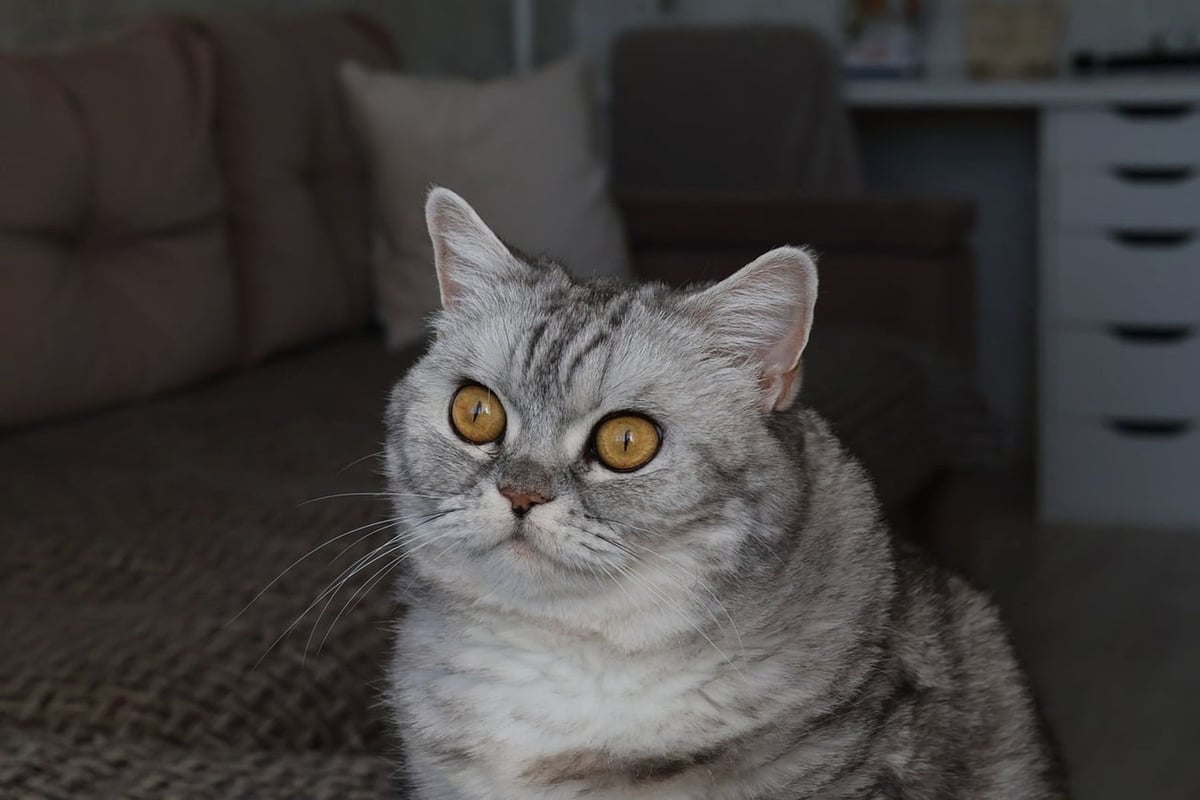
Scottish Straight
The Scottish Straight is the Scottish Fold with straight ears: the same rounded cobby build, the same placid, discreet temperament, but without the characteristic ear fold. Recognized by TICA as a breed in its own right, it plays a central role in ethical Fold × Straight breeding programs that avoid the Fd/Fd homozygotes responsible for severe feline osteochondrodysplasia. Its longhaired version is called the Highland Straight.
- Weight
- 3 to 6kg
- Height
- 28 to 36cm
- Life expectancy
- 14years
- Monthly cost
- 70 to 120€
Personality profile
Energy 2/5
Independence 3/5
Trainability 3/5
Good with children 4/5
Talkativeness 2/5
Space needed 3/5
Attachment to home 4/5
Good with strangers 3/5
Good with cats 3/5
Good with dogs 3/5
Coat care 2/5
Exercise needs 2/5
Scores given on measured axes, data confidence: medium.
Living with a Scottish Straight
Description
The build is cobby, compact and muscular, a trait common to the whole Scottish family. The head is round and broad, with full cheeks, a short muzzle, a firm chin and large round eyes with a gentle expression — often gold, green or blue-green depending on the coat. The ears are straight, small to medium, well open and tilted slightly forward, which gives it a look of serene alertness completely unlike the Fold's "owl" silhouette. The body is stocky, the legs medium-length and round, the tail full and of good length. The coat is short, dense and soft in texture, without the British's excessive undercoat — thick enough to protect but easy to maintain. The color palette is very wide: solid, tabby, bicolor, tortie, colorpoint, silver and golden. Males reach 4 to 6 kg, females 3 to 4.5 kg. Life expectancy: 12 to 15 years.

Temperament
The character is the Scottish Fold's, trait for trait: calm, devoted, low-demand for stimulation and remarkably discreet vocally. It is affectionate without being intrusive — it follows its owners, settles nearby, but doesn't impose physical contact. Its patience with children is solid, and it accepts cohabiting with other cats or properly introduced dogs without difficulty. It's neither a relentless hunter nor an acrobat: it prefers elevated lookout spots to frantic dashes. Past age two, its energy settles into a peaceful cruising pace. It copes fairly well with daytime solitude, but appreciates regular rituals — meals, short play sessions, gentle presence — that structure its day.
Training
It's not a learning athlete, but its quiet intelligence and attachment to its owners make it receptive to positive reinforcement. It learns to answer to its name, and to accept carrier transport and veterinary handling if socialization begins early. Sessions should be short — five minutes maximum — never coercive, and punctuated with food rewards counted into the daily ration. Regular environmental enrichment (food puzzles, rotating toys) compensates for its low need for spontaneous play and prevents excessive sedentary behavior.

Feeding
Moderate to hearty appetite, a rather slow metabolism: weight management is the central concern of the diet. Two split daily meals with measured portions are preferable to free feeding. Favor a diet rich in animal protein, moderate in fat and low in carbohydrates to preserve muscle mass without encouraging fat storage — particularly important in neutered indoor cats. Taurine must be present in adequate amounts for heart support. After 7-8 years, a senior formula that preserves kidney function is advised, possibly supplemented with omega-3 fatty acids (EPA/DHA) for the aging cat's joint comfort — to discuss with the vet.
Affiliate links, no extra cost to you. Legal notice

Living conditions
Apartment life suits it perfectly: a low energy level and its composed temperament make it easy in modest-sized spaces. A sturdy scratching post, one or two elevated spots (a windowsill, a stable cat tree) and a few interactive play sessions a week are enough for its balance. Its good cold tolerance — a Scottish legacy — and its solid thermoregulation make it adaptable to most European indoor environments. The breed's natural sedentary tendency calls for weight monitoring, particularly after neutering: free feeding is not recommended.

Grooming and coat care
The short, dense coat is among the easiest to maintain. A weekly brushing with a fine metal comb is enough to remove dead hair and keep the coat's soft texture. During the seasonal molts (spring, fall), increase to two to three times a week for two to three weeks to limit hair ingestion. A grooming glove can be enough outside the molts. No regular bathing is required. Check the straight ears regularly — they're more exposed to wax buildup than the Fold's folded ears, and a gentle monthly cleaning is enough for prevention. Clean the eyes if discharge appears.

Health
Everything here hinges on the Fd (Folded) gene, responsible for the ear fold across the Scottish family. This gene exists in two alleles: Fd, dominant, carrying the TRPV4 V342F mutation identified in 2016, and fd, the normal allele. Since Fd is dominant, a single copy is enough to fold the ears — a straight-eared cat is therefore fd/fd, with no copy of the mutation at all. That's the whole health advantage of the Straight: its straight ears are visible proof that it is not a carrier, with no DNA test required. It is not affected by the feline osteochondrodysplasia (OCD) linked to this mutation, will not pass it on to its offspring, and no specific joint monitoring is therefore called for. The other two genotypes, by contrast, define folded-eared cats: Fd/fd, the heterozygote, which is the Scottish Fold of responsible breeding programs, and Fd/Fd, the homozygote, affected by near-systematic severe OCD. Hence the Straight's central role in ethical breeding: serious programs ban the Fold × Fold pairing, the only one capable of producing Fd/Fd cats, and practice exclusively Fold (Fd/fd) × Straight (fd/fd). Statistically, half the litter is born with straight ears and entirely unaffected, the other half heterozygous. A serious breeder documents the pairings of their breeding cats — ask for this information when buying. Outside of Fd genetics, the breed is generally robust. No cardiac predisposition (HCM) specific to the Scottish family is documented with the prevalence seen in the British Shorthair or the Maine Coon, but echocardiographic monitoring remains good practice. Obesity is the main metabolic risk.
Breed history
The Scottish family originates in 1961 on a farm in Perthshire, Scotland: a white queen named Susie had ears that naturally folded forward, a spontaneous mutation never before seen in the domestic breed. William Ross, a neighboring breeder, took a kitten from her litter and started a selection program. The straight-eared kittens born from these matings — the future Scottish Straights — were, from the outset, produced in equal numbers to the Folds, but were long considered mere "byproducts" of the program. International recognition soon exposed the ethical limits of the selection: the GCCF (Great Britain) withdrew its registrations as early as 1971 over joint health concerns linked to the Fd gene; the FIFe followed. The CFA recognized the Scottish Fold in 1978 and TICA in 1979. This fragmented recognition pushed responsible breeders to formalize the Scottish Straight's place as an essential breeding partner rather than a secondary breed: it is the Straight — and only the Straight in Europe — that can legitimately be paired with the Scottish Fold without producing Fd/Fd homozygotes. TICA today recognizes the Scottish Straight and the Scottish Straight Longhair (Highland Straight) as fully distinct breeds in their own right, on the same footing as their folded-eared counterparts. The LOOF, aligned with the FIFe's European standards, is not among the registries that officially list the breed to date — French breeders working with Folds often use the Scottish Straight in outcrossing while operating under a regulatory framework that varies by association.
Getting ready for your Scottish Straight
Four essentials to line up before day one.
Affiliate links, no extra cost to you. Legal notice
FAQ: Scottish Straight
Sources
- Wikipedia EN — Scottish Fold (Fd genetics, OCD, TRPV4) · TRPV4 V342F mutation identified in 2016. Genotypes Fd/Fd (severe OCD), Fd/fd (heterozygous), fd/fd (unaffected). GCCF withdrew recognition in 1971. TICA and CFA in championship status.
- TICA — Browse All Breeds (Scottish Straight recognized) · Scottish Straight and Scottish Straight Longhair listed among the 73 breeds recognized in championship status by TICA.
- Wikipedia FR — Scottish Fold · Fold × Scottish Straight mating (its direct equivalent, minus the folded ears) recommended in Europe. Susie, founding queen, 1961, Perthshire, Scotland.
- Royal Canin FR — Scottish Fold · Calm, loyal temperament, vocally discreet. Easy cohabitation with children and other animals. Life expectancy 12-15 years.

