


Ojos Azules
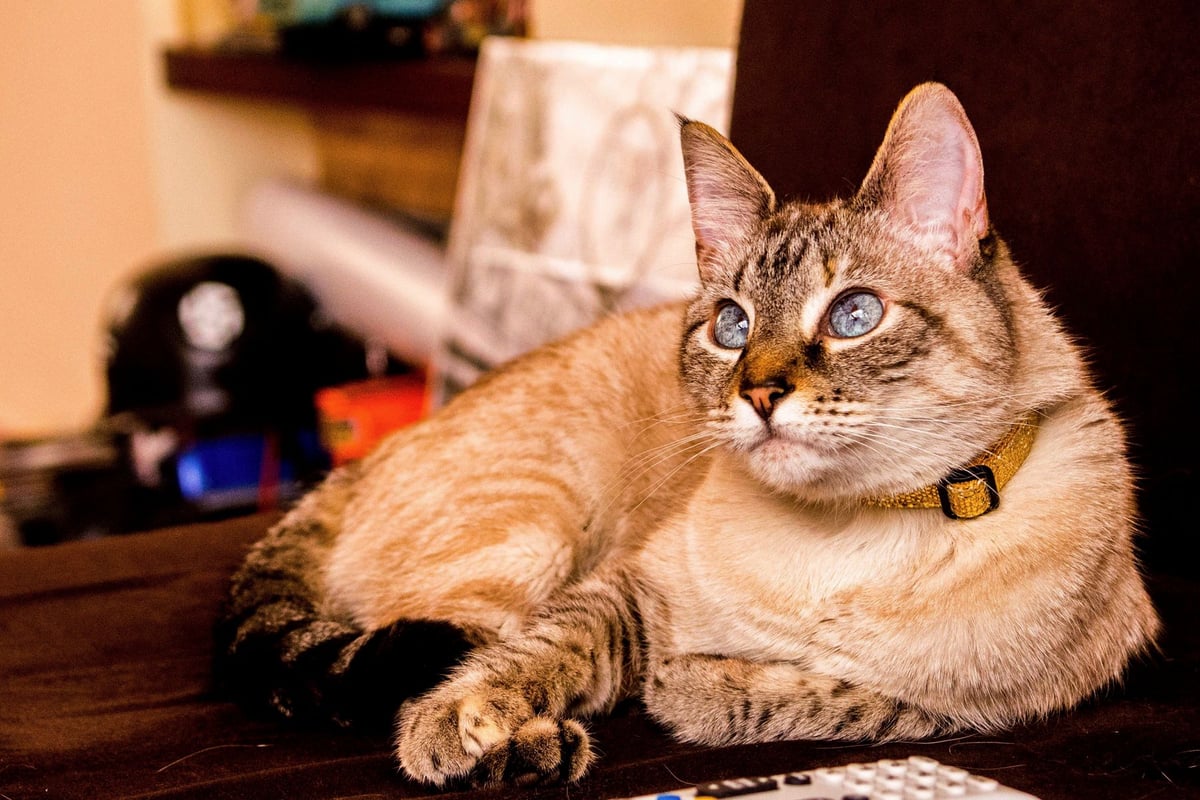
The Ojos Azules — Spanish for "blue eyes" — is an American breed born in New Mexico in 1984, unique in the world for its ability to express intensely blue eyes independently of coat color: a phenomenon genetically distinct from Siamese colorpoint and the dominant white gene. Registered in preliminary status with TICA since 1991, it remains among the rarest breeds in the world, almost absent from France. Its singular beauty is inseparable from a severe biological constraint: the gene responsible for the eye color is lethal in the homozygous state, which structurally limits its expansion.
- Weight
- 3 to 6kg
- Height
- 25 to 35cm
- Life expectancy
- 13years
- Monthly cost
- 60 to 110€
Personality profile
Energy 3/5
Independence 3/5
Trainability 3/5
Good with children 4/5
Talkativeness 2/5
Space needed 2/5
Attachment to home 4/5
Good with strangers 3/5
Good with cats 4/5
Good with dogs 3/5
Coat care 2/5
Exercise needs 3/5
Scores given on measured axes, data confidence: medium.
Living with an Ojos Azules
Description
The build is medium, semi-foreign, with a muscled and well-proportioned body, without morphological exaggeration. The head is moderately wedge-shaped, slightly longer than wide, with soft cheekbones and a medium-length muzzle. The stop is slight, with no pronounced break. The ears are medium to large, broad at the base, slightly rounded at the tip, well set. The breed's most remarkable trait is unquestionably its eye color: an intense, deep, luminous blue, found regardless of coat color — solid, tabby, bicolor, tortie coats — whereas in every other known breed, intense blue is reserved for white cats or those carrying the colorpoint gene. This blue results from a single dominant gene, provisionally designated Ob (Ojos Bleu), whose genetic transmission is autosomal dominant. The tail is medium length, slightly tapered. The coat is short, dense and silky, close to the body. All coat colors are possible, except pure white and colorpoint patterns. Males reach 4 to 6 kg, females 3 to 4.5 kg.

Temperament
The few breeders who work with the breed describe an affectionate, curious and sociable cat, without being intrusive. It enjoys human company and develops sincere bonds with its owners, readily being cuddly during calm moments. Its activity level is moderate: it alternates phases of exploration and play with long rest periods. Its hunting instinct remains present but is not as pronounced as in breeds with a strong working heritage such as the Bengal or the Abyssinian. Its vocalizing is rare and discreet. It cohabits without notable friction with other cats or respectful children. Its adaptable nature and balanced temperament make it a versatile companion, although behavioral data from breeding programs remains limited due to the breed's rarity.
Training
Intelligent and attentive, this cat is receptive to routines and positive reinforcement. It can learn to answer to its name, to use its carrier, and to tolerate routine care if socialization began early. Its motivation level for active learning is comparable to that of the European Shorthair or the American Shorthair — decent without reaching the receptiveness of the Bengal or the Maine Coon. Short sessions of 5 to 10 minutes, based on food rewards or play, give better results than long sessions. A kitten well socialized from the first weeks will be docile for vet visits and handling.

Feeding
No specific nutritional needs are documented for the breed. Quality food high in animal protein — premium kibble or wet food — suits its medium build. The ration should be adapted to actual weight, age and activity level: a moderately active 4 kg adult needs roughly 200-240 kcal/day. Two split meals a day are preferable to free-feeding for neutered individuals. Constant access to fresh water, ideally via a circulating fountain, is recommended.
Affiliate links, no extra cost to you. Legal notice

Living conditions
Apartment or house, the breed adapts without difficulty. Its moderate activity level and medium size make it compatible with most common living arrangements. An enriched environment — cat tree, rotating toys, access to watchable windows — is enough for its balance. It handles daytime solitude reasonably well provided absences are not permanent. Its rarity in France and worldwide means in practice that a prospective buyer will most likely have to turn to specialized North American breeders, with the associated delays and importation costs. Access to a secure outdoor space — enclosure or netted balcony — is appreciated but not essential.

Grooming and coat care
The short, silky coat is among the simplest to maintain. A weekly brushing with a grooming glove or fine metal comb is enough to remove dead hair and preserve the coat's lustrous look. During seasonal shedding, step up to two sessions a week for two to three weeks. No regular bathing is necessary. Check the ears periodically and clean if needed with a suitable veterinary product. Claws should be monitored every three to four weeks in individuals living exclusively indoors.

Health
The breed's central health issue is the Ob gene (Ojos Bleu), autosomal dominant, responsible for the blue eye color. In the heterozygous state (Ob/+), this gene confers the characteristic blue eyes with no known clinical consequence. In the homozygous state (Ob/Ob), it causes severe craniofacial malformations: craniosynostosis, congenital blindness, cleft palate and almost systematic neonatal death. Like the dominant white gene (W), Ob is a dominant gene that acts on pigmentation, but it follows a distinct developmental pathway and does not cause the same damage. The breeding program absolutely requires the Ob/+ × +/+ cross (heterozygote with a non-carrier cat): each litter statistically produces 50% blue-eyed Ob/+ cats and 50% normal-eyed +/+ cats, eliminating any Ob/Ob risk. An Ob/+ × Ob/+ cross — forbidden in any serious program — would produce 25% lethal homozygous carriers. This irreducible biological constraint is the main reason the breed has never been able to develop on a large scale: half of every litter does not display the phenomenon that defines the breed, and any relaxation of the breeding protocol produces fatal births. No other major hereditary predisposition is documented in the breed, but the clinical database remains very limited due to its rarity.
Breed history
The history of the Ojos Azules begins in 1984 in New Mexico, when a tortoiseshell female named Cornflower was noticed for her unusually intense blue eyes — all the more surprising since her coat was non-colorpoint, which, according to the knowledge of the time, should have ruled out any possibility of deep blue eyes. Cornflower's descendants quickly confirmed the phenomenon: the transmission of the blue eyes is dominant and independent of the colorpoint pattern, the white gene, and any other mechanism known in feline genetics up to that point. This singularity drew the attention of geneticists: the UC Davis Veterinary Genetics Laboratory would study the breed and confirm that it involves an autosomal dominant mutation distinct from all other known mutations affecting eye pigmentation in cats. In 1991, TICA granted the Ojos Azules Preliminary New Breed status. The breeding program advances cautiously because of the discovery of the lethal risk in homozygosity: Ob/Ob carriers are born with craniofacial malformations incompatible with life. TICA temporarily suspended registrations in the 1990s to better characterize the gene. It was only in the early 2000s that the breed resumed structured breeding activity, mainly in the United States. To this day, worldwide numbers remain almost anecdotal: a few dozen to a few hundred cats at most, all from very closely supervised programs. The breed is absent from France, nonexistent in the LOOF or FIFe registries, and its eventual accession to TICA Championship status remains suspended as long as the lethal homozygous risk is not fully controlled across a larger breeding population.
Getting ready for your Ojos Azules
Four essentials to line up before day one.
Affiliate links, no extra cost to you. Legal notice
FAQ: Ojos Azules
Sources
- TICA — Ojos Azules breed information · The Ojos Azules is registered with TICA at preliminary New Breed status since 1991. Autosomal dominant Ob gene, blue eyes independent of colorpoint, Ob/+ × +/+ cross mandatory to avoid homozygous lethality.
- UC Davis Veterinary Genetics Laboratory — Feline coat color genetics · Ob mutation distinct from the colorpoint gene (cs) and the dominant white gene (W). Autosomal dominant transmission confirmed. Ob/Ob homozygosity associated with lethal craniofacial malformations: craniosynostosis, cleft palate, neonatal death.
- Wikipedia EN — Ojos Azules · Breed discovered 1984 New Mexico, tortoiseshell female Cornflower. TICA Preliminary New Breed 1991. Ob gene: heterozygote with no adverse effect, homozygote lethal (craniofacial malformations). Numbers close to nil. Ob/+ × +/+ cross only.

