


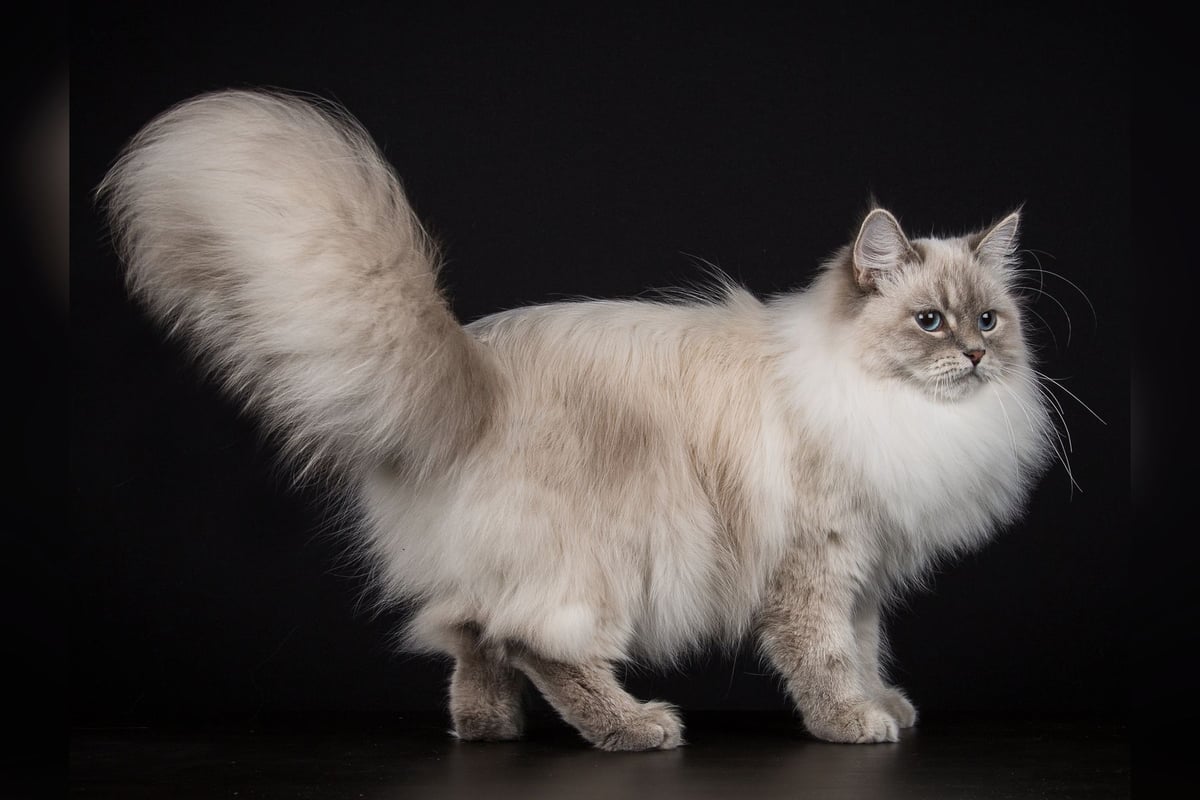
Neva Masquerade
The Neva Masquerade is the colorpoint variant of the Siberian, developed in Saint Petersburg on the banks of the Neva in the 1970s-1980s. Its name evokes the Neva River and the dark facial mask characteristic of the colorpoint pattern. A large, robust breed with a waterproof triple coat and always-intense blue eyes, it shares the morphology and active temperament of the classic Siberian. Its federal status is ambiguous: a distinct breed with the WCF and the GCCF, a colorpoint variety of the Siberian with the LOOF and the FIFe. In France, it is registered with the LOOF under the designation Siberian colorpoint.
- Weight
- 4 to 9kg
- Height
- 28 to 38cm
- Life expectancy
- 16years
- Monthly cost
- 65 to 110€
Personality profile
Energy 4/5
Independence 3/5
Trainability 3/5
Good with children 4/5
Talkativeness 3/5
Space needed 4/5
Attachment to home 4/5
Good with strangers 3/5
Good with cats 4/5
Good with dogs 4/5
Coat care 4/5
Exercise needs 4/5
Scores given on measured axes, data confidence: medium.
Living with a Neva Masquerade
Description
The silhouette is that of the Siberian, semi-cobby: a massive body, a slightly arched back, powerful limbs with hind legs higher than the front — which gives it remarkable jumping ability. The head is round and broad, the muzzle moderately short, the ears medium-sized with internal tufts and lynx tips. The triple coat is the distinctive element: a dense down layer, an intermediate (awn) layer and a waterproof outer coat, longer on the flanks, tail and britches. The ruff is well developed, especially in winter. The coat must follow the colorpoint pattern: a cream-to-white body, with the extremities — facial mask, ears, legs and tail — in a noticeably darker shade. Admitted colors include seal, blue, red, cream, and their tabby and tortie-point variants. The eyes are always blue, with a mandatory sapphire intensity (mechanism detailed in the FAQ). Solid white cats do not belong to the breed. Males 6-9 kg, females 4-6 kg; full physical maturity around 4-5 years. Life expectancy 14-18 years.

Temperament
The temperament is that of the classic Siberian, often described as "dog-like": it follows its owners from room to room, greets visitors with curiosity rather than fright, and interacts actively rather than simply observing from a perch. Its vocalizing is moderate — soft trills and expressive chirps — without reaching the insistence of the Siamese. Playful and a born hunter, it retains an athletic energy well beyond kittenhood and calls for daily stimulation. It cohabits without difficulty with children, other cats and properly introduced dogs. Its sociability is real but not clingy: it enjoys human presence without depending on it excessively. The breed shows notable operational intelligence, able to manipulate simple mechanisms (doors, dispensers) and solve foraging games.
Training
It is a capable learner, motivated mainly by play and interaction rather than treats alone. Its curiosity and operational intelligence make it receptive to clicker training for agility exercises — obstacle courses, jumps, recall to name — which effectively channel its athletic energy. The harness is generally well tolerated with gradual introduction from kittenhood. Sessions should be short (5-10 minutes), consistently positive and varied so as not to bore a cat that gets bored quickly. No physical restraint: the breed is sensitive to coercion and can shut down for a long time. Foraging games and kibble dispensers, placed at different heights, provide effective daily cognitive stimulation that usefully complements physical exercise.

Feeding
A large breed with slow growth and an active metabolism, it needs calorie intake matched to its size, especially during the development phase (up to 5 years). For an active 6-7 kg adult, plan for 260-330 kcal/day depending on activity level and season (higher needs in winter for cats with outdoor access). Favor kibble rich in animal protein (≥38%) and taurine for cardiac support, in line with the HCM predisposition. For kittens up to 15 months, choose a large-breed-specific food with a balanced calcium/phosphorus ratio. The breed can be prone to weight gain after neutering: monitor its silhouette and adjust the ration accordingly. Two split daily meals are preferable to free-feeding.
Affiliate links, no extra cost to you. Legal notice

Living conditions
It needs enough space to express its high energy — a cramped apartment is not advisable. A home of at least 60 m² fitted with vertical structures (a cat tree 2 meters or taller, wall shelves), or ideally a house with a garden, form the foundation for sustained daily athletic activity. Its waterproof triple coat and northern robustness make it one of the rare pedigree cats that can benefit from secure outdoor access without behavioral risk — a large enclosed space is a major asset. A breed of subarctic origin, it tolerates cold perfectly but suffers from heat above 24-25 °C: a cool room, ventilation and permanently available water are essential in summer. Avoid apartments with no usable height: the motor frustration of a climber of this size quickly leads to destructive behavior. A netted, secured balcony is a considerable asset.

Grooming and coat care
The triple coat needs brushing 2 to 3 times a week in steady state to prevent mats, particularly on the ruff, britches and base of the tail — regular grooming is non-negotiable. During intense seasonal shedding (spring above all, when the winter undercoat sheds heavily), step brushing up to daily for 3 to 4 weeks. Use a wide-toothed metal comb for the outer coat, then a fine comb for the down. The coat's waterproof structure limits wet grooming: a bath is rarely necessary (1-2 times a year) and difficult, since water runs off without soaking in. Check the ear and toe tufts monthly. The colorpoint areas (mask, legs, tail) require no specific care, but eye discharge, slightly more frequent in colorpoint breeds, should be cleaned regularly with a damp cotton pad to prevent marks on the facial mask.

Health
The genetic predispositions are those of the Siberian. Hypertrophic cardiomyopathy (HCM) is the major cardiac risk: with no MyBPC3 mutation identified specific to the breed (as in the Maine Coon), screening relies on annual echocardiograms of breeding cats from age 2. In a pet cat, a first baseline exam around 2-3 years gives a point of comparison, with closer follow-up from 6-7 years. Polycystic kidney disease (PKD) has been documented in the breed; although less frequent than in the Persian, a PKD1 DNA test is worth requesting from the breeder. The breed is known for relatively low levels of Fel d 1 (the major feline allergen) — no study allows it to be officially classified as hypoallergenic, but anecdotes of tolerance are frequent among mildly allergic people. Unlike white cats carrying the W gene (dominant white), the blue eyes here stem from the cs colorpoint gene, with no link to genetic deafness. Life expectancy 14-18 years; the breed is generally hardy provided HCM and PKD screening is carried out.
Breed history
The breed emerged in the 1970s-1980s in Saint Petersburg, on the banks of the Neva River, from colorpoint Siberian cats present in the local population. Its name combines the Neva River with "Masquerade", an English term evoking the dark facial mask characteristic of the colorpoint pattern. Russian breeders developed and stabilized this variant, initially controversial among classic Siberian breeders who saw the colorpoint as evidence of crossing with the Siamese or the Balinese. The question of its federal status remains open: the WCF and the GCCF recognize it as a fully distinct breed, while the FIFe, the LOOF and the North American federations TICA and CFA treat it as a color variety of the Siberian, registered under the same standard with the simple addition of the colorpoint pattern. In France, the LOOF therefore registers it under the designation Siberian colorpoint (SIB). This duality affects neither the morphological standard (identical to the Siberian's), nor the temperament, nor the breeding requirements.
Getting ready for your Neva Masquerade
Four essentials to line up before day one.
Affiliate links, no extra cost to you. Legal notice
FAQ: Neva Masquerade
Sources
- Wikipedia EN — Neva Masquerade · Siberian colorpoint breed, origin Neva River (Saint Petersburg), 1970s-1980s. Waterproof triple coat, mandatory blue eyes (cs gene). PKD and HCM predispositions. Federal status: distinct breed with WCF/GCCF, colorpoint variety with FIFé/TICA/CFA.
- Wikipedia FR — Siberian (cat) · Neva Masquerade = colorpoint variety of the Siberian, blue eyes and a light coat with dark extremities. Recognized by the LOOF, FIFé, WCF, GCCF. Life expectancy 15-20 years. Crossing between colorpoint and classic variants permitted.
- Royal Canin — Siberian Profile · Males 7-8 kg, females 5.5-6 kg (28-33 cm). Waterproof triple coat, lynx tips, bushy tail. Brushing 2-3x/week. HCM and weight management to watch. Neva Masquerade mentioned as the colorpoint variant.
- LOOF — Recognized cat breeds · The Siberian (including the Neva Masquerade colorpoint variety) is among the breeds officially recognized by the Livre Officiel des Origines Félines.

