


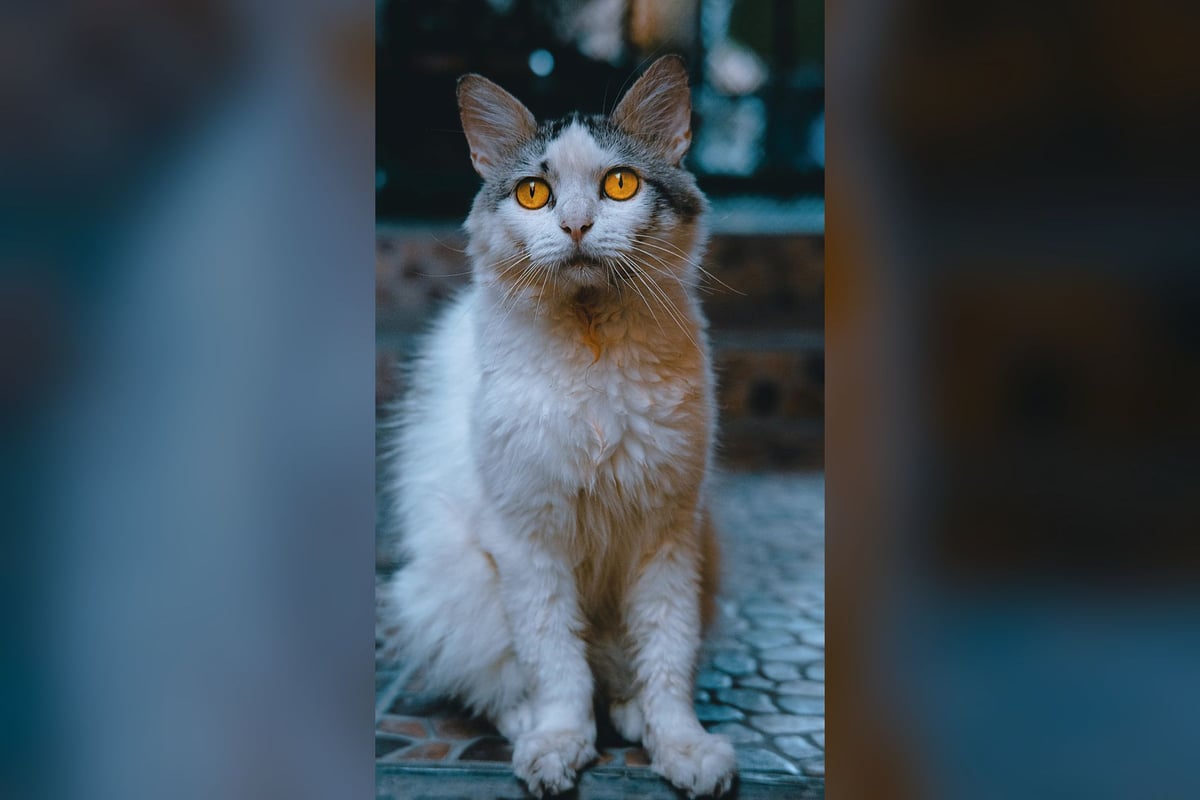
LaPerm
The LaPerm is an American breed born in 1982 on an Oregon farm, when a farm cat gave birth to a bald kitten that later grew a spectacular curly coat. Its unique dominant mutation produces soft spirals reminiscent of mohair — neither Devon Rex nor Cornish Rex, but an entirely independent genetics. A medium-sized breed (3 to 5 kg), active and curious, it stands out for a sincere human attachment with no need for constant presence, and for robust health with no documented breed-specific conditions.
- Weight
- 3 to 5kg
- Height
- 20 to 28cm
- Life expectancy
- 14years
- Monthly cost
- 60 to 100€
Personality profile
Energy 4/5
Independence 3/5
Trainability 4/5
Good with children 4/5
Talkativeness 3/5
Space needed 3/5
Attachment to home 4/5
Good with strangers 4/5
Good with cats 4/5
Good with dogs 4/5
Coat care 3/5
Exercise needs 3/5
Scores given on measured axes, data confidence: medium.
Living with a LaPerm
Description
The build is semi-foreign and elegant: a muscular body of moderate length, relatively long legs, a well-defined neck, with no excess in any direction. The head forms a triangle with rounded contours, carrying medium-sized, well-spaced ears whose insides show characteristic curly locks — the "ear furnishings" — very distinctive in longhairs. The eyes, almond-shaped and slightly oblique, accept every color with no requirement to match the coat. The coat is the most striking feature: soft, airy curls, tight spirals at the throat and the base of the ears, long, wavy whiskers that twist to the sides. Two varieties coexist: the Shorthair, with soft waves on the back and belly and a silky texture; the Longhair, with tight curls, a ruff at the chest and a plumed tail. In both cases, the undercoat is light, and dead hairs shed naturally into the curls — which explains the small amounts of hair found around the home. Every color and pattern is allowed. Males generally weigh 4 to 5 kg, females 3 to 4 kg, for a height at the withers of 20 to 28 cm.

Temperament
Active, curious and affectionate, it seeks contact without ever imposing it. It follows its owners from room to room, readily climbs onto shoulders, settles on laps whenever the chance arises — but accepts solitude with an independence that more dependent breeds like the Sphynx lack. Its practical intelligence makes it receptive to interactive games, food puzzles and short training sessions. Its curiosity is active: it explores, opens drawers, inspects new objects with sustained attention. Its vocalizing is moderate — it communicates through small meows and trills, without the persistence of a Siamese. It gets along well with children who respect its limits, and with other cats as well as with dogs introduced gradually. Its broad sociability makes it a good candidate for multi-pet households.
Training
Curious intelligence and relational motivation make it a receptive learner, without reaching the intense trainability of a Sphynx or a Bengal. It quickly learns its name, responds to recall, can learn to give a paw or use a puzzle feeder. Clicker training works well: sessions of 5 to 8 minutes, twice a day, show results within a few weeks. Its main motivation is relational reward (an enthusiastic voice, petting) as much as food. Its active curiosity means it also learns through independent exploration — better to give it rich environments than to keep it in an impoverished space. Any punitive signal is counterproductive and breaks trust: exclusive positive reinforcement is the only method suited to this sensitive temperament.

Feeding
No particular nutritional need is tied to the breed. A balanced premium diet, rich in animal protein (minimum 35%) and taurine, covers its needs at every life stage. Wet food and kibble can be combined to ensure good hydration — all the more useful since cats fed exclusively on dry food are often in chronic fluid deficit. An active 4.5 kg adult male eats roughly 200 to 250 kcal a day; a 3.5 kg female, 160 to 200 kcal. Two split meals a day are preferable to free feeding, which encourages snacking and weight gain after neutering. Weight should be watched from age 6 onward: activity drops with age without appetite following the same curve. Kittens in a rapid growth phase (2 to 12 months) benefit from a high-energy-density kitten food.
Affiliate links, no extra cost to you. Legal notice

Living conditions
Apartment life poses no difficulty, as long as the environment is enriched enough to channel its energy and curiosity: cat trees, high observation posts, varied toys refreshed regularly. Secure outdoor access (an enclosure, a netted balcony) is appreciated but not essential. Its temperature tolerance is balanced — neither fragile in the cold like the Sphynx, nor especially hardy like double-coated northern breeds. In an apartment, daily interactive play sessions (15 to 20 minutes) are enough to cover its exercise and physical activity needs. Its ability to stay alone for a few hours without distress makes it compatible with households where owners work, provided regular isolation does not exceed 8 to 10 hours without animal or human company. A calm companion cat can make up for the absence.

Grooming and coat care
The curly coat is counterintuitive: it needs less care than a classic long coat, and, paradoxically, less than a dense short coat. The curls hold onto dead hair instead of letting it scatter around the home, which limits hair on furniture and clothing. A wide-toothed metal comb used once or twice a week is enough to maintain the curl structure and remove the rare tangle. Standard brushing should be avoided: it breaks the curls and generates static electricity. During the seasonal molt (mainly spring), the comb can be used daily for two weeks. Bathing, which the breed tolerates well, should be followed by air-drying or a gentle towel dry — never a high-powered hair dryer, which produces a "frizz" effect unfavorable to the spiral structure. Weekly ear cleaning (particularly the inner furnishings, which can trap dirt) and claw care every three weeks round out the routine.

Health
This is one of the few breeds for which vets and official registries agree that no documented breed-specific hereditary condition has been identified to date. Born from a spontaneous mutation in a farm population — a diverse genetic base — and managed without a major genetic bottleneck, it shows a rare constitutional robustness for a recently created breed. Life expectancy runs between 12 and 15 years, with cats regularly reaching 18 to 20 years according to TICA breeder accounts. Routine care is enough: annual vaccinations, antiparasitics, dental scaling if needed, and an annual vet checkup. There is currently no breed-specific DNA test recommended — worth watching if the population grows significantly. Vigilance remains warranted for conditions common to the feline species as a whole (cardiomyopathies, kidney problems with age) with no documented additional risk specific to this breed.
Breed history
The story of the LaPerm begins on March 1, 1982, on a cherry farm in The Dalles, Oregon, owned by Linda and Richard Koehl. Their farm cat, Speedy, gave birth to a litter of six kittens, one of which, a female, was born entirely bald — an anomaly that Linda Koehl, surprised but not alarmed, observed without intervening. At six weeks old, the little cat began to develop a sparse, curly coat. Named "Curly," she grew into a robust cat with a spectacular fur of soft spirals. Linda Koehl did not intervene in the breeding for years: the dominant mutation spread naturally through the farm population, and curly cats multiplied without a formal program. It was a cat show judge, visiting the farm in 1992, who encouraged Linda to enter these unusual cats in shows. The breed made its debut on the American show circuit in 1994 and immediately drew the judges' attention. TICA granted championship status in 2003; the CFA followed in 2008. In Europe, the breed arrived gradually through the 2000s and was registered with the LOOF in the distinctive-coat category. It remains a little-known breed in France today — a few dozen annual LOOF registrations — but enjoys a community of dedicated breeders who maintain the population's genetic diversity.
Getting ready for your LaPerm
Four essentials to line up before day one.
Affiliate links, no extra cost to you. Legal notice
FAQ: LaPerm
Sources
- Wikipedia FR — LaPerm · Breed born in 1982 in Oregon, the cat Curly. Dominant mutation independent of the other rex breeds. LOOF recognition, distinctive-coat category.
- Wikipedia EN — LaPerm · Founder Curly born March 1, 1982, Koehl farm, Oregon. TICA championship 2003, CFA 2008. Coat: soft waves and ringlets, textured mohair feel, minimal shedding. Dominant gene.
- LOOF — LaPerm · Breed officially recognized by the LOOF, distinctive-coat category. Semi-foreign body. Two varieties: shorthair (waves) and longhair (tight curls, ruff). All colors admitted.
- TICA — LaPerm Breed · Bald kitten at 0 weeks, first curly coat at 6 weeks. Males 7-12 lbs, females 6-9 lbs. No breed-specific diseases documented. Life expectancy 12-15 years, sometimes 20.
Breeds similar to a LaPerm

