


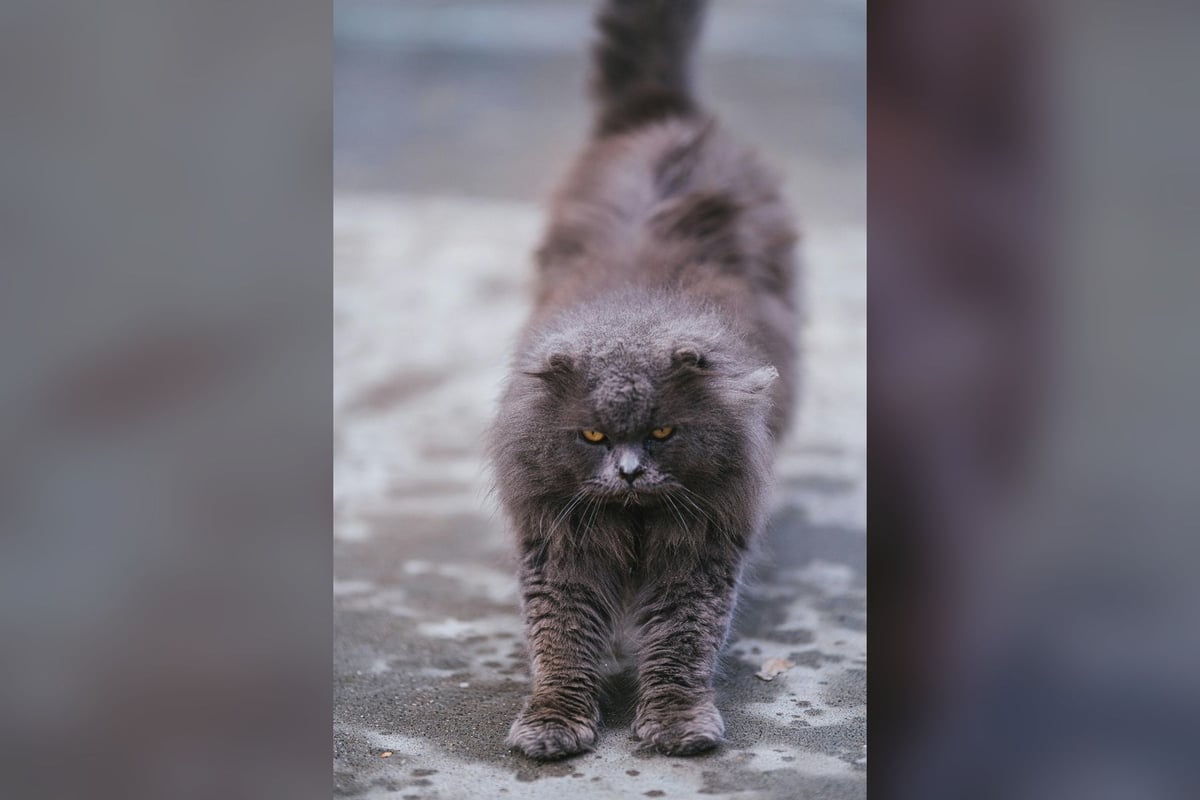
Highland Fold
The Highland Fold is the semi-longhair variant of the Scottish Fold: the same cobby build, the same folded ears from the dominant Fd gene, the same placid temperament — but a dense, silky coat that needs regular brushing. It appeared as early as the first litters of Susie (1961), and is recognized by the LOOF, TICA (as the Scottish Fold Longhair from 1987-88) and the CFA (1993-94). Like its shorthair twin, it carries the same Fd gene and therefore the same incurable bone disease — feline osteochondrodysplasia — which makes it one of the most ethically debated breeds in the international veterinary community.
- Weight
- 3 to 6kg
- Height
- 28 to 35cm
- Life expectancy
- 13years
- Monthly cost
- 80 to 140€
Personality profile
Energy 2/5
Independence 3/5
Trainability 3/5
Good with children 4/5
Talkativeness 2/5
Space needed 2/5
Attachment to home 4/5
Good with strangers 3/5
Good with cats 3/5
Good with dogs 3/5
Coat care 3/5
Exercise needs 2/5
Scores given on measured axes, data confidence: high.
Living with a Highland Fold
Description
The build follows the Scottish Fold's cobby shape point for point: a broad, perfectly round head, full cheeks, a domed forehead, a short muzzle and round, expressive eyes that create the characteristic "owl" look. The one substantial difference from the Scottish Fold lies in the coat: semi-long, dense, with a well-developed undercoat and decorative tufts at the extremities — around the ears, legs and tail. This coat is controlled by the recessive l (longhair) gene, distinct from the Fd gene responsible for the folded ears: a kitten must inherit two copies of the l gene (genotype l/l) to express the long coat, in addition to one copy of the Fd gene (genotype Fd/fd in any cat from a responsible breeding program) to have folded ears. The ears come in three degrees of folding identical to those of the Scottish Fold. The coat accepts every color and pattern. Weight: 3 to 6 kg. The tail must stay supple — any stiffness is a clinical sign of severe OCD involvement.

Temperament
The temperament is that of the Scottish Fold down to the last detail: placid, discreet, attached without being possessive. It follows its owners with quiet curiosity, settles nearby rather than in laps, and expresses itself through light, infrequent meows. Its tolerance of handling is high, which makes it a popular choice for families with children capable of respecting an animal's limits. It cohabits without tension with other cats and with properly introduced dogs. Not very demanding, it copes with daytime absences without showing visible distress. Its calm behavior can, in a cat suffering from OCD, mask chronic pain: the cat keeps observing and taking part in household life without radically changing its behavior, which complicates the diagnosis of pain. Play sessions are short and low-intensity; curiosity stays present well into old age.
Training
Receptiveness to learning is the same gentle kind found in the Scottish Fold: it is not a high-performance breed, but its quiet intelligence and discreet attachment to its owners make it cooperative with structured routines. Priority should go to early socialization to veterinary care — handling of the paws, ears and tail — since orthopedic consultations will be frequent throughout its life. Add habituation to brushing from a young age: a cat that accepts the brush without resistance makes the regular grooming its semi-long coat requires much easier. Sessions should be very short (3 to 5 minutes), based exclusively on positive reinforcement. In a cat in pain, any forceful handling of sensitive areas can trigger unusual reactions — always work gently and watch for withdrawal signals.

Feeding
Feeding follows the same requirements as the Scottish Fold's, with particular attention to excess weight — an aggravating factor for joints weakened by OCD. Favor food rich in animal protein, moderate in carbohydrates, and enriched with omega-3 fatty acids (EPA and DHA) for their documented anti-inflammatory properties. Foods containing glucosamine and chondroitin provide relevant preventive cartilage support given the breed's systematic OCD predisposition. Two measured daily meals — never free feeding, particularly for sedentary neutered cats. Monthly weight checks are advisable. After 7-8 years, switch to a senior formula with moderate caloric density.
Affiliate links, no extra cost to you. Legal notice

Living conditions
It suits apartment life very well. Its moderate energy level, vocal discretion and compact frame make it a well-balanced housemate even in a medium-sized space. It does not need imposing climbing structures, but a few perches at a reasonable height let it indulge its taste for observation. A sturdy scratching post, occupier toys and access to a window are enough for its daily balance. Its semi-long coat calls for extra attention to ventilation in summer — heat tolerance is moderate. Watching for signs of joint pain (stiffness, altered gait, reluctance to jump) matters more than spatial arrangements: a cat suspected of OCD should not have to get down from high surfaces under its own power.

Grooming and coat care
The semi-long coat needs regular brushing 2 to 3 times a week with a wide-toothed metal comb to untangle the dense undercoat without damaging the outer coat. A grooming glove rounds out the routine, removing loose surface hair. During the seasonal molts (spring and fall), step up to daily brushing for 2 to 3 weeks to prevent mats, particularly in friction zones (armpits, hocks, behind the ears) and in the ruff. The tufts around the ears and extremities need to be untangled frequently. The folded ears create a confined space that favors wax buildup: weekly cleaning with a suitable veterinary product is essential. Regularly check for any suspicious odor or abnormal discharge in the ear canals. The corners of the round eyes can accumulate discharge; daily cleaning with an unscented damp cloth prevents irritation. No frequent bathing is needed if regular brushing is kept up.

Health
The breed shares exactly the same central health risk as the shorthaired Scottish Fold: feline osteochondrodysplasia (OCD), directly caused by the dominant Fd gene that defines the breed's folded ears. The semi-long coat does nothing to soften this predisposition — the l (longhair) gene and the Fd gene are independent, and the bone disease is a consequence of the Fd genotype alone. The mechanism is identical: the Fd gene disrupts normal cartilage development throughout the body. In Fd/Fd homozygotes — from Fold × Fold crosses, across all varieties — the condition is consistently severe and early-onset: fusion of the caudal vertebrae, exostoses of the legs and hocks, intense chronic pain. These cats suffer; Fold × Fold crossing is universally condemned by the veterinary community. In Fd/fd heterozygotes — from a cross with a Scottish Straight, a Highland Straight or a British Longhair — the condition is less severe but very common: according to radiographic studies, most cats show detectable bone abnormalities on imaging even without obvious clinical signs. Clinical warning signs: stiffness or shortening of the tail (an early sign of OCD), lameness, altered gait, reluctance to jump, an abnormally hunched posture, sensitivity to touch on the hind legs or the base of the tail. Diagnosis relies on radiographs of the distal limbs and the caudal spine. There is no curative treatment: management is palliative (anti-inflammatories, painkillers, joint-support diet). An orthopedic veterinary consultation within the first 6 months is recommended for every kitten of the breed, regardless of the absence of apparent symptoms. FIFe refuses to recognize the breed for this reason; Belgium and the Netherlands have legislated, or plan to, against breeding cats that carry the Fd gene.
Breed history
The history of the Highland Fold is inseparable from that of the Scottish Fold: as early as the first litters of Susie, the folded-eared cat discovered in 1961 on a farm near Dundee, longhaired kittens appeared. This is explained by the presence of the recessive l (longhair) gene in the lines of farm cats crossed with the first Scottish Folds. Long treated as an informal curiosity within the breed, longhaired cats were gradually recognized under the name Highland Fold — a reference to the Scottish Highlands — or Scottish Fold Longhair depending on the federation. TICA was the first organization to formally recognize them for championship competition, during the 1987-88 show season. The CFA followed in 1993-94. In France, the LOOF recognizes the variety under the name Highland Fold. The breed shares the entire ethical controversy surrounding the Scottish Fold: the same Fd gene, the same OCD disease, the same legislative debates in Northern Europe. The growing popularity of folded-ear cats on social media in the 2010s affected both varieties, amplifying the risks tied to careless breeding.
Getting ready for your Highland Fold
Four essentials to line up before day one.
Affiliate links, no extra cost to you. Legal notice
FAQ: Highland Fold
Sources
- Wikipedia FR — Scottish Fold (Highland Fold section) · Longhair variety named Highland Fold, appeared as early as Susie's first litters (1961). Semi-long coat recognized by the LOOF, TICA and CFA. Same Fd gene, same OCD risk as the shorthaired Scottish Fold.
- Wikipedia EN — Scottish Fold (Longhair variety) · Longhair variant known as Highland Fold, Scottish Fold Longhair, Longhair Fold, or Coupari. TICA first to recognize for championship 1987-88 show season; CFA followed 1993-94. Characteristic tufts at the extremities.
- LOOF — Recognized cat breeds · The Highland Fold is among the breeds officially recognized by the Livre Officiel des Origines Félines, semi-longhair category. Fold × Fold crossing not permitted by serious affiliated breeders.
- Malik et al. — Osteochondrodysplasia in Scottish Fold cats (J Feline Med Surg, 1999) — via PMC · Clinical and radiographic study of feline OCD in the Scottish Fold. Bone abnormalities documented in both the Fd/Fd and Fd/fd genotypes, across all varieties (short and long coat). Caudal vertebral lesions, exostoses of the distal limbs. No curative treatment.

