


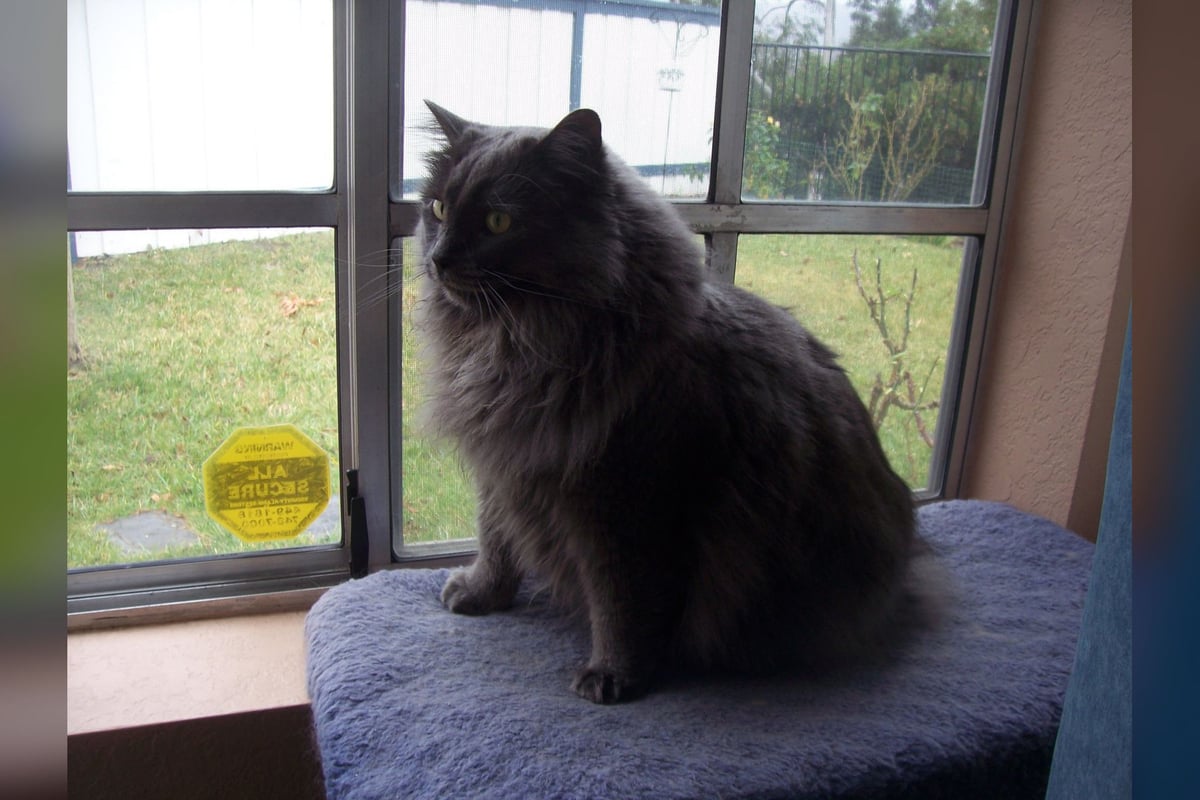
Cymric
The Cymric is the semi-longhair version of the Manx, carrying the same taillessness mutation that arose on the Isle of Man. Its stocky cobby body, raised hindquarters and distinctive gait make it instantly recognizable. The breed carries a serious genetic stake: the gene responsible for taillessness is lethal in the homozygous state, and a proportion of kittens develop Manx syndrome, an irreversible spinal and neurological condition. Breeding it requires rigorous selection and early veterinary monitoring.
- Weight
- 3 to 5.5kg
- Height
- 25 to 35cm
- Life expectancy
- 13years
- Monthly cost
- 65 to 120€
Personality profile
Energy 3/5
Independence 3/5
Trainability 3/5
Good with children 4/5
Talkativeness 2/5
Space needed 3/5
Attachment to home 4/5
Good with strangers 3/5
Good with cats 4/5
Good with dogs 3/5
Coat care 3/5
Exercise needs 3/5
Scores given on measured axes, data confidence: medium.
Living with a Cymric
Description
The build is markedly cobby: a short, stocky, solidly muscled body, dense bone structure, a broad, rounded chest. A distinctive trait: the hind legs are noticeably longer than the front legs, raising the hindquarters and giving the breed its rolling gait, often described as that of a trotting rabbit. The head is round and broad, with full cheeks, well-spaced ears that are slightly rounded at the tip. The coat is semi-long to long, dense, with a well-developed double layer — a thick woolly undercoat and a silky outer coat. A ruff develops around the neck, breeches are prominent on the hind legs and the tail plume is full. All traditional colors and patterns are accepted, except colorpoint in some registries. The breed's most variable trait is the tail: four morphotypes are recognized depending on how the Mx gene expresses. The "rumpy" is entirely tailless, sometimes with just a palpable dimple where the last caudal vertebrae would be. The "rumpy-riser" has a very short stub, not visible to the eye but palpable. The "stumpy" has a 2 to 5 cm stub of partially fused vertebrae. The "longy" (or "taily") has a tail that looks almost normal but is shortened. Males: 4 to 5.5 kg. Females: 3 to 4.5 kg. Average life expectancy: 12 to 15 years in individuals not affected by Manx syndrome.

Temperament
An affectionate, level-headed cat, it is attached to its home without being intrusive. It builds close bonds with its owners and follows them discreetly through their daily activities, without demanding constant attention. Its temperament is generally gentle and calm: it tolerates respectful children and cohabits without major friction with other cats introduced gradually. Its vocalizing is rare and discreet — it expresses itself little, unlike oriental breeds. It stays playful into adulthood, with moderate activity: it enjoys mock-hunting sessions and interactive games, without the intensity of a Bengal or an Abyssinian. Its unusual build — longer hind legs, rolling gait — does not stop it from being agile and jumping effectively. It is generally open to strangers after a brief observation period, without excessive wariness. Its natural sturdiness and even temper make it a cat well suited to stable families.
Training
This is a cooperative cat, responsive to positive reinforcement. It easily learns household routines — using a carrier, tolerating brushing, accepting veterinary care — provided socialization starts early and progressively. For individuals who need neurological follow-up (Manx syndrome), getting kittens used to hindquarter handling, abdominal palpation and regular veterinary exams from the moment they arrive is a practical priority. Short sessions (5 to 8 minutes), built around treats or play, give better results than long ones. Its moderate energy level does not predispose it to intense agility exercises, but regular hunting games (feather wands, moving toys) keep its mental sharpness and physical condition up.

Feeding
The breed has no specific nutritional needs, but its stocky build and moderate activity level call for weight monitoring. Favor a diet high in animal protein (≥35%), moderate in fat and low in carbohydrates. Two split meals a day are preferable to free feeding, particularly after neutering. Individuals affected by megarectum or chronic constipation linked to Manx syndrome benefit from a high-fiber diet and increased hydration — a partial wet-food ration is then recommended. A taurine-enriched diet supports heart function over the long term. For kittens, a premium kitten diet is recommended up to 12 months.
Affiliate links, no extra cost to you. Legal notice

Living conditions
It adapts to life in an apartment as well as a house, provided its environment is enriched. A standard-sized apartment (40 to 60 m²) with a few accessible vertical structures, a scratching post and rotating toys is enough for its balance. Its moderate energy level does not require large spaces, but regular mental and physical stimulation remains essential to prevent boredom. Access to a secure outdoor space — netted balcony, catio — is a valuable enrichment. Its cold tolerance is decent thanks to its double coat. That said, particular vigilance is needed for individuals affected by Manx syndrome: a house without steep stairs or significant heights makes daily life easier for them if motor or sensory problems are present. Cohabiting with dogs is workable provided the introduction is gradual and respects feline cues.

Grooming and coat care
The semi-long double coat needs regular brushing but remains less demanding than a Persian's or a Himalayan's cottony coat. Under normal conditions, two to three brushings a week are enough to remove dead hair and prevent matting. Use a wide-toothed metal comb to detangle the outer coat, followed by a fine comb for the undercoat. The areas prone to matting are behind the ears, the armpits and the breeches — inspect these first at every session. During the spring seasonal shed, the undercoat drops heavily: step up to four sessions a week for three to four weeks. Bathing stays rare (once or twice a year), as the coat is not very prone to odor or dirt buildup. Clean the ears periodically with a suitable veterinary product. Trim the claws every three to four weeks for cats kept strictly indoors.

Health
The health profile is dominated by two genetic realities inseparable from the breed: the homozygous lethality of the Mx gene and Manx syndrome. Mx gene and homozygous lethality. The gene responsible for taillessness (identified as a mutation of the brachyury gene in 2013) has autosomal dominant inheritance. Cats carrying a single copy (Mx/+) survive and display the various tail morphotypes. Cats carrying two copies (Mx/Mx) are not viable: they die through in-utero fetal resorption, statistically accounting for about 25% of conceptions in any Cymric × Cymric litter. This mechanism makes breeding fully homozygous cats impossible, and explains why litters are structurally smaller than average. Manx syndrome. This is the breed's most serious condition. The syndrome covers a set of developmental malformations of the lumbosacral spine, caused by excessive expression of the Mx gene on the terminal vertebrae. Available studies indicate that about 30% of the rumpies studied are affected — the most severe forms mainly involving tailless individuals (rumpies), in whom the mutation expresses with the greatest intensity. Clinical signs include: partial spina bifida (incomplete closure of the dorsal vertebral arch), megarectum (abnormal distension of the rectum causing severe constipation), urinary and/or fecal incontinence from damage to the lumbosacral nerves controlling the bladder and rectum, gait disturbances or partial paralysis of the hind limbs in severe cases. Symptoms generally appear between 4 and 6 months, sometimes earlier. A kitten that is asymptomatic at 6 months is considered unlikely to develop a severe form, though this is not an absolute guarantee. Detection and ethical breeding. No DNA test currently screens for Manx syndrome before clinical symptoms appear — diagnosis relies on behavioral observation (urination and defecation problems, abnormal gait) and imaging (X-ray or MRI of the lumbosacral spine). Serious breeders avoid mating two rumpies together, favoring rumpy-risers and stumpies, which express the gene with less intensity. Every kitten should receive close veterinary follow-up between birth and six months of age. Kittens showing signs of Manx syndrome need palliative care (constipation management, bladder catheterization if needed, pain relief). No curative treatment exists. Hypertrophic cardiomyopathy (HCM) is documented in the breed with no precise prevalence published to date; echocardiographic monitoring of breeding cats from age 2 is recommended as a precaution.
Breed history
The Cymric's history begins on the Isle of Man, a small island territory between Great Britain and Ireland. The island's geographic isolation favored the fixation of a spontaneous mutation of the brachyury gene, causing the absence or marked reduction of the tail in local cats. This island population, known as the Manx, forms the genetic base of the breed. Longhaired cats likely existed within the Manx population for a long time, but it was in Canada, in the 1960s-1970s, that breeders deliberately selected and developed the long-coated variant. Canadian breeder Blair Wright and American Leslie Falteisek are credited with the first standardization work on the longhaired breed. The name chosen by these Canadian breeders is itself a nomenclature curiosity, unrelated to the breed's Manx origin. The Canadian Cat Association was the first organization to recognize it, in 1970. The American CFA (Cat Fanciers' Association) accepted it in 1989 under the designation "Longhaired Manx," rejecting the name Cymric and treating it as a Manx variety rather than a distinct breed. TICA (The International Cat Association) and some European organizations recognize it under the name Cymric as a breed in its own right. In France, neither the Manx nor the Cymric appears among the breeds recognized by the LOOF — the breed remains little known in France and continental Europe, more present in English-speaking countries and North America. The ethical stakes tied to Manx syndrome have slowed its development in structured breeding. Discussions about selection ethics have led several organizations, including the British GCCF, to strictly regulate pairings.
Getting ready for your Cymric
Four essentials to line up before day one.
Affiliate links, no extra cost to you. Legal notice
FAQ: Cymric
Sources
- Wikipedia FR — Cymric (cat) · Origin Isle of Man, island brachyury gene mutation. Canadian breeders Blair Wright and Leslie Falteisek, 1960s-70s. Name Cymric from Welsh Cymru. CCA recognition 1970, CFA 1989 as Longhaired Manx. Tail morphotypes: rumpy, rumpy-riser, stumpy, longy.
- Wikipedia EN — Manx cat (genetics and syndrome) · Dominant brachyury gene identified 2013. Mx/Mx homozygotes lethal in utero (~25% of conceptions). Manx syndrome: spina bifida, megarectum, incontinence, hindquarter paralysis — affects ~30% of rumpies studied. Ethical breeding: avoid rumpy × rumpy crosses. GCCF and ACF regulate pairings.
- Wikipedia EN — Cymric cat · Breed developed in Canada in the 1960s-70s. Semi-long coat, dense double layer. Medium body 3-5 kg. Longer hind legs. TICA and FIFé recognize it as a distinct breed; CFA treats it as a Manx variety.
- LOOF — Recognized cat breeds · Neither the Cymric nor the Manx appears among the breeds officially recognized by the LOOF at the time of writing (May 2026).

