


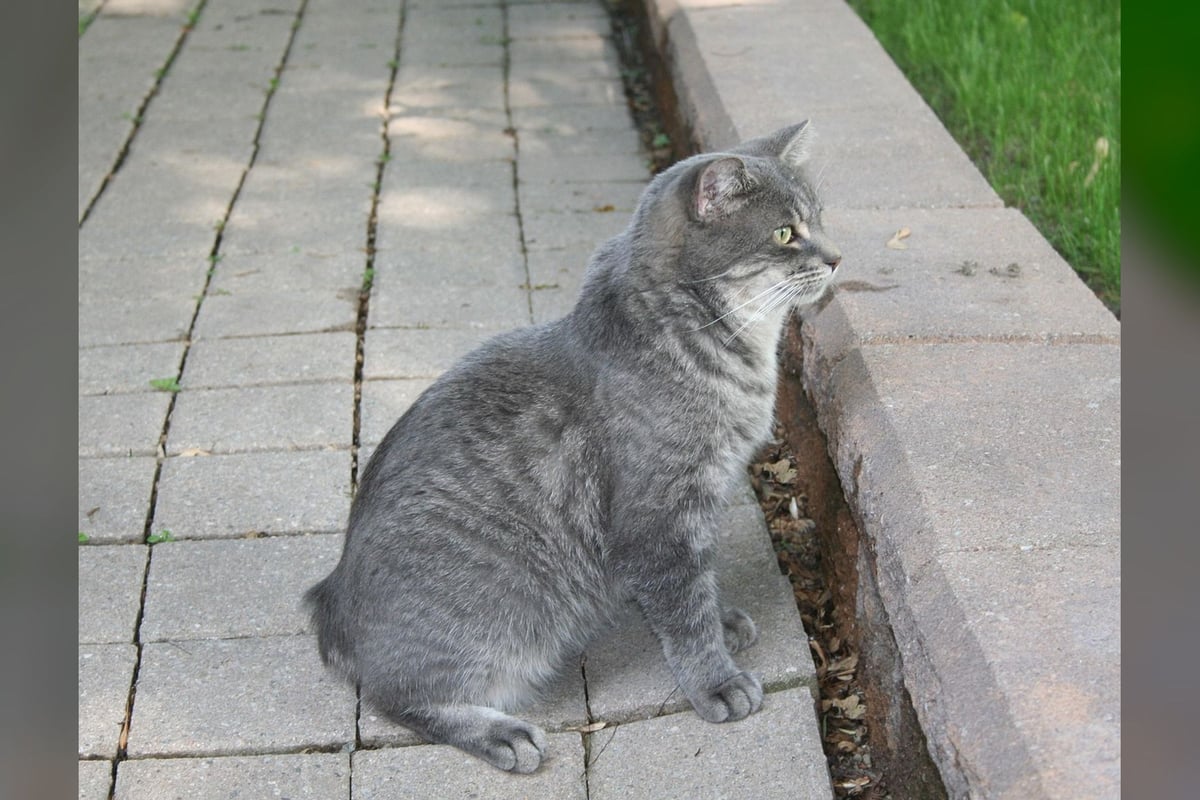
Manx
The Manx is an ancient breed originating from the Isle of Man, known worldwide for its total absence of a tail or its variable stub, its very round cobby silhouette and its characteristic rabbit-like gait. Sociable, intelligent and attached to its people, it carries a dominant gene whose double dose is lethal — which calls for rigorous breeding and attentive veterinary follow-up.
- Weight
- 3.5 to 5.5kg
- Height
- 28 to 36cm
- Life expectancy
- 13years
- Monthly cost
- 60 to 110€
Personality profile
Energy 3/5
Independence 3/5
Trainability 4/5
Good with children 4/5
Talkativeness 2/5
Space needed 3/5
Attachment to home 4/5
Good with strangers 3/5
Good with cats 4/5
Good with dogs 4/5
Coat care 2/5
Exercise needs 3/5
Scores given on measured axes, data confidence: high.
Living with a Manx
Description
The Manx shows a pronounced cobby build: a short, massive body, deep flanks, a short, arched back forming a continuous curve from shoulder to hip. The hindquarters are raised by hind legs noticeably longer than the front legs — a structural asymmetry that gives it its characteristic rolling gait, often compared to a rabbit's trot. The head is round, with wide, full cheeks, a short muzzle and a well-defined chin; seen from the front, it resembles a bulldog; in profile, a small bear. The eyes are round and large, the ears medium-sized and well spaced. The coat is short with a dense double layer and a thick undercoat; every color and pattern is accepted. Adult males generally weigh 4 to 5.5 kg, females 3.5 to 5 kg. Full maturity is not reached until age 5. Four tail categories coexist within the breed: the "rumpy" is entirely tailless, with a hollow or a simple dimple where the tail would attach; the "rumpy-riser" has a cartilaginous stub that is not visible but can be felt, and sometimes rises with emotion; the "stumpy" has a short, mobile, jointed stub 2 to 5 cm long; the "longy" has an almost normal tail. In CFA and TICA shows, only rumpies and rumpy-risers are accepted in championship class; stumpies and longies remain, all the same, valuable breeding cats for the breed's genetic health.

Temperament
It is often described as having a "dog-like" character — a label that reflects its taste for physical closeness with its owners, its tendency to follow them from room to room, and its receptiveness to structured interactions unusual for a cat. It learns to fetch toys, reliably responds to its name and can be taught leash walking with patience. Its attachment is sincere without being intrusive: it enjoys human presence, asks for attention on its own terms, but also knows how to occupy itself alone. Its vocalizing is soft and discreet — rare, low-register meows, very far from a Siamese's vocal temperament. Playful and lively into old age, it keeps a streak of mischief that many cobby-bodied breeds lose as they get older. It cohabits without tension with children who respect it, with other cats and with properly introduced dogs. With strangers, it shows initial reserve before approaching on its own terms. Its tolerance of veterinary handling is good when it has been socialized young.
Training
Few shorthaired breeds are as receptive to training. Its practical intelligence and attachment to its owners make it a cooperative subject for positive reinforcement: it learns to respond to its name, come on command, fetch a toy and tolerate regular veterinary handling without resistance — claw care, ear cleaning, examination of the hindquarters. Leash walking is possible with a gradual introduction starting in kittenhood. Sessions should stay short (5 to 10 minutes), regular and never coercive. Early socialization to visitors, household noises and other animals is decisive: a kitten well socialized between 4 and 12 weeks develops lasting confidence.

Feeding
No specific nutritional need is tied to the breed, aside from those caused by possible digestive complications. Food rich in animal protein, moderate in carbohydrates and with a suitable fiber content is recommended, particularly for cats prone to constipation or megarectum. Two measured daily meals — avoid free feeding for sedentary neutered cats, which gain weight easily. Ensure permanent access to fresh water, ideally via a circulating fountain. For kittens, a dedicated high-calorie-density kitten food up to 12 months; for adults with megarectum, a vet may recommend a high-fiber diet.
Affiliate links, no extra cost to you. Legal notice

Living conditions
Apartment or house, it adapts, provided its environment offers enough mental stimulation and surfaces to explore. Its moderate activity level and compact frame make it compatible with average-sized spaces; it does not need a garden but makes full use of one if access is secure. Vertical structures, a sturdy scratching post and regular play are enough for its indoor balance. Its unusual build — raised hindquarters and an arched spine — calls for care around slippery surfaces and high jumps, particularly for cats whose spinal health is being monitored. Its cold tolerance is good, in keeping with the Isle of Man's winters. It handles summer heat moderately well with no particular issue.

Grooming and coat care
The short double coat needs moderate care. Brushing twice a week with a fine metal comb or a grooming glove is enough to remove dead hair and preserve the coat's natural density. During the seasonal molt — spring and fall — step up to three times a week for two to three weeks to reduce shed hair around the home and limit ingestion during self-grooming. The dense undercoat can form localized tangles behind the ears and under the armpits in some thicker-coated cats; regularly checking these areas prevents matting. No regular bathing is needed. Clean the ears periodically and watch for wax buildup. Claws should be trimmed every three to four weeks for indoor cats. Regular monitoring of the hindquarters is recommended for cats with mild sacral abnormalities.

Health
The breed's health is inseparable from the genetics that define it. The gene responsible for the absence of a tail — designated Mx or M depending on the source — is a dominant allele of the T brachyury gene. This dominance has a direct, non-negotiable consequence: cats carrying two copies of the gene (Mx/Mx homozygotes) are not viable. Homozygous embryos die in utero from arrested spinal development, and litters are systematically smaller than average (3 to 4 kittens on average). All living Manx cats are therefore Mx/+ heterozygotes — carriers of a single copy of the gene — which does not prevent the trait from expressing itself, nor, unfortunately, a range of vertebral complications. Manx syndrome is the breed's central health risk. It is a set of neurodevelopmental malformations linked to incomplete or abnormal development of the lumbosacral region of the spine. Manifestations include: spina bifida (unclosed vertebral arches), a shortened or absent sacrum, megarectum (chronic rectal dilation causing severe constipation), urinary and/or fecal incontinence from sphincter denervation, and paralysis or paresis of the hind legs in severe cases. These abnormalities result from an early neural migration defect and are not a consequence of trauma or environment. The syndrome affects roughly 20 to 30% of cats according to available studies, with a higher prevalence among rumpies (fully tailless). The diagnostic window is critical: symptoms appear and become detectable within the first 4 to 6 months of life. A kitten showing no clinical signs at 6 months is considered unlikely to develop the syndrome as an adult — but this favorable outlook must be established by a vet after a clinical exam and, where possible, imaging of the lumbosacral region. There is no curative treatment. Management is palliative: medical management of constipation (a suitable diet, mild laxatives, manual stimulation), urinary catheterization in case of retention, pain relief for spasms. Severely affected cats have a reduced life expectancy of 3-4 years and need intensive daily care. Ethical breeding: serious practices strictly avoid the rumpy × rumpy cross (two tailless parents), which maximizes the proportion of homozygotes in the litter and statistically worsens the syndrome. Responsible breeding pairs a tailless cat with a normal-tailed domestic cat, or with a stumpy or a longy, to maintain allelic diversity. Some registries, including FIFe, have imposed breed-specific breeding restrictions for these reasons. Veterinary follow-up of kittens at 4, 6 and 12 weeks is recommended, with a neurological exam including pelvic reflexes, anal tone and palpation of the sacral region — then a final check around 6 months, the end of the diagnostic window described above. Consulting a vet experienced with genetically at-risk breeds is strongly advised before acquisition. Beyond the syndrome, the breed carries an increased risk of megarectum unrelated to the syndrome (idiopathic primary dilation), corneal dystrophy, and early osteoarthritis of the hind legs linked to the structural asymmetry. A healthy cat's life expectancy is 12 to 14 years.
Breed history
The Manx is one of the best-documented cat breeds in terms of its antiquity. Its territory of origin — the Isle of Man, an archipelago of the Irish Sea politically attached to the British Crown but distinct from the United Kingdom — played a decisive genetic role: the island's geographic isolation created the conditions for a population bottleneck in which the spontaneously arising taillessness mutation spread and became fixed through insular inbreeding over several centuries. The earliest documented depictions of tailless cats on the Isle of Man date to the 17th century; a painting attributed to 1810 is among the most frequently cited iconographic references. Several popular legends attempt to explain the absence of a tail: the Manx is said to have been the last cat to board Noah's Ark, its tail caught in the door at the last moment; or soldiers are said to have cut kittens' tails to decorate their helmets, prompting mother cats to bite off their litters' tails to spare them. These stories, still alive in Isle of Man folk culture, obviously have no biological basis. The genetic reality is more recent in its formalization: the mutation is located on the brachyury (T) gene, whose dominant truncated allele (Mx) disrupts the development of the tail and sacrum. The breed was one of the first shown at the major British cat shows of the late 19th century, notably at the Crystal Palace in London in the 1890s. The CFA (Cat Fanciers' Association) recognized it as early as the first decades of the 20th century, making it one of the association's founding breeds. TICA recognized it for championship competition in June 1979. The semi-longhair variant — the Cymric, identical in every respect except the coat — was gradually recognized by the major federations from the 1970s-1980s onward. Today, the breed is rare in France, more common in the United Kingdom, North America and Australia. Its breeding is subject to restrictions in several registries because of the genetic risks tied to Manx syndrome. Serious breeders keep rigorous litter-tracking records, document each kitten's tail category and work closely with specialized vets for early screening. The breed remains at the center of a moderate ethical debate — less intense than the one surrounding the Scottish Fold, but real — over the compatibility between selecting for a structural anomaly and animal welfare.
Getting ready for your Manx
Four essentials to line up before day one.
Affiliate links, no extra cost to you. Legal notice
FAQ: Manx
Sources
- Wikipedia FR — Manx (cat) · Breed from the Isle of Man, absence of a tail from a dominant mutation. Mx gene: homozygotes not viable. Four categories: rumpy, riser, stumpy, longy. Longer hind legs. Manx syndrome: spina bifida, incontinence, megarectum. First documented in the 17th century.
- Wikipedia EN — Manx cat · Dominant brachyury gene. Mx/Mx homozygotes lethal in utero (reabsorption). 20-30% of Manx cats develop the syndrome. Rumpy at highest risk. Male weight 4.5-5.5 kg, female 3.5-4.5 kg. Litters of 3-4 kittens. TICA champion since 1979. Breeding restrictions in several registries.
- TICA — Manx breed profile · TICA championship breed since June 1979. Compact cobby body, longer hind legs, rabbit-like gait. Dog-like temperament, playful, sociable, attached to owners.
- PetMD — Manx cat breed · Manx syndrome: neurological damage to the spine, bladder, colon. No curative treatment. Arteriosclerosis, megarectum, corneal dystrophy. Health insurance and a breeder who tests for genetic diseases recommended. Dog-like temperament documented.

