


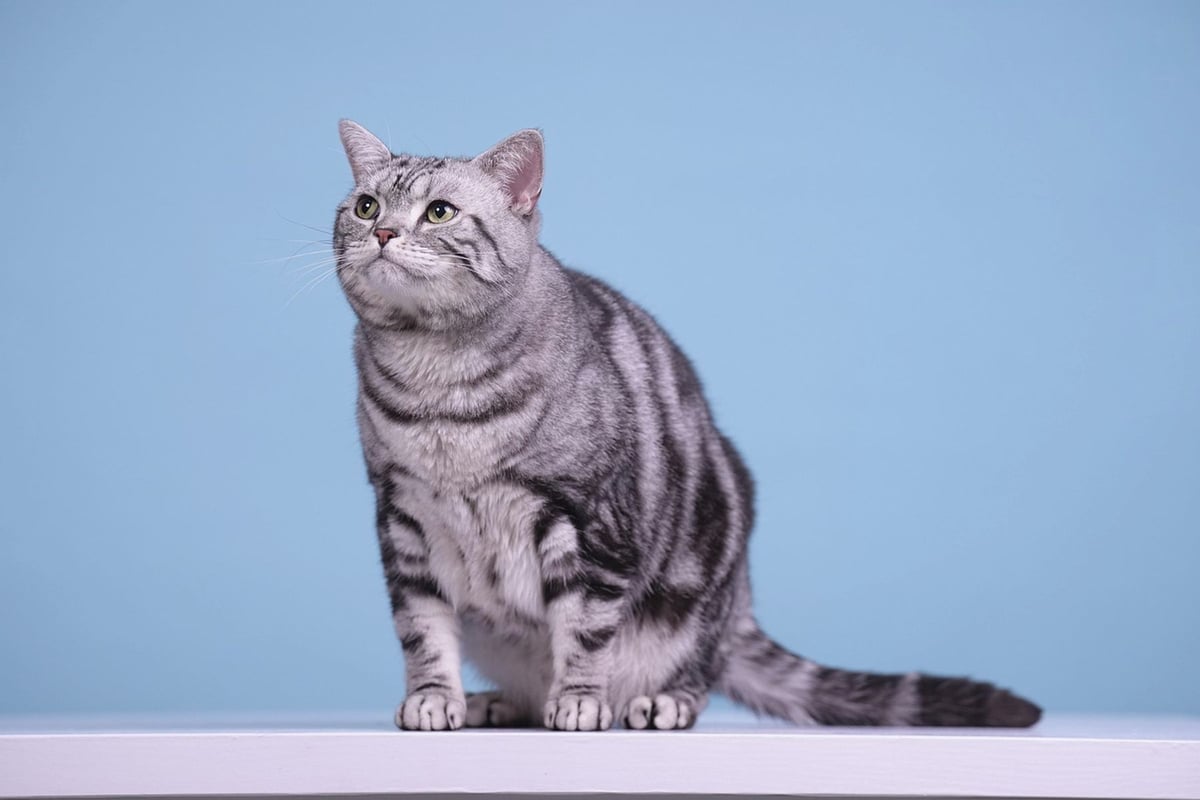
American Shorthair
The American Shorthair is the pedigree version of the American colonial farm cat, a direct descendant of the cats carried aboard early settlers' ships to protect provisions from rodents. A muscular semi-cobby body, more than 80 recognized colors and patterns — including the classic silver tabby that has become the breed's emblem —, and a balanced, no-extremes temperament. One of the CFA's five founding breeds in 1906, it is uncommon in France but ranks in the top 10 in the United States.
- Weight
- 3.5 to 7kg
- Height
- 28 to 38cm
- Life expectancy
- 17years
- Monthly cost
- 50 to 90€
Personality profile
Energy 3/5
Independence 4/5
Trainability 3/5
Good with children 4/5
Talkativeness 2/5
Space needed 3/5
Attachment to home 3/5
Good with strangers 3/5
Good with cats 4/5
Good with dogs 4/5
Coat care 2/5
Exercise needs 3/5
Scores given on measured axes, data confidence: high.
Living with an American Shorthair
Description
The build is semi-cobby and substantial: a muscular, powerful body, solid bone structure, broad chest, with no exaggerated feature. Neither size nor type leans toward extremes — the breed is built for function rather than morphological spectacle. The head is broad, slightly longer than wide, with full, well-developed cheeks that give the adult male his characteristic stocky look. The muzzle is powerful and well-defined, the chin firm. The eyes, large and almond-shaped with a slight upward slant, are open and expressive. The ears are medium-sized, slightly rounded at the tip. The coat is short, dense and hard to the touch — a double layer built to protect against the weather and minor injuries, a legacy from its working ancestors. The color and pattern palette recognized by the CFA exceeds 80 combinations: solid, bicolor, tabby (classic, mackerel, spotted), smoke, shaded, silver and golden. The classic silver tabby — a silver background crossed with deep black marbling — is the breed's most emblematic pattern and the most represented in shows. Males reach 5 to 7 kg, females 3.5 to 5.5 kg, with marked sexual dimorphism.

Temperament
The American Shorthair's temperament is often described as the calibrated average of the feline world: neither velcro cat nor hermit, neither inert nor hyperactive. It maintains an affectionate, sincere relationship with its owners without developing pathological dependence — it enjoys company and readily follows from room to room, without demanding constant attention. Its hunting instinct remains intact and well developed: it hunts methodically in a garden, invents prey in an apartment, and stays noticeably alert to movement. This hunter's edge is not hyperactivity — its phases of exploration and play alternate naturally with long calm periods. Its vocalizing is rare and discreet, almost silent even in greetings. It cohabits without notable friction with children who respect feline boundaries, and with other cats or dogs introduced gradually. Its tolerance of strangers is decent without being enthusiastic — it sizes up the situation before approaching. Its emotional resilience to changes in routine is one of its most concretely practical strengths.
Training
It is an intelligent, attentive cat, receptive to routines and positive reinforcement. It can learn to answer to its name, tolerate carrier transport and accept routine care without resistance if socialization starts early. Its motivation for active learning is moderate — comparable to the European Shorthair's, below the Bengal's or the Maine Coon's. Short, regular sessions of 5 to 10 minutes based on food rewards or play give better results than long sessions. A kitten well socialized from its first weeks is remarkably docile for vet visits and travel.

Feeding
No nutritional need is specific to this breed. A quality diet high in animal protein — premium kibble or wet food — works well. The ration should be matched to actual weight and activity level: a moderately active 5 kg adult needs roughly 230-260 kcal/day. Neutered individuals have a marked tendency to gain weight; avoid free feeding and prefer two measured meals a day. Constant access to fresh water, ideally via a circulating fountain, is recommended.
Affiliate links, no extra cost to you. Legal notice

Living conditions
The breed adapts equally well to apartment life and to a house with a garden, provided its stimulation needs are met. In an apartment, vertical structures, rotating toys and access to watchable windows let it express its hunting instinct without notable frustration. In a house with secure outdoor access, it becomes an active territory prowler and an opportunistic hunter. Its cold tolerance is good, consistent with its origins as a colonial working cat exposed to northeastern American winters. Its moderate activity level makes it compatible with a busy household without a constant presence — it handles daytime solitude without particular anxiety. A sturdy scratching post and a few daily interactive play sessions are enough for its mental balance. The breed suits families with young children, households with other cats, and most common living arrangements.

Grooming and coat care
The short, dense coat is among the simplest to maintain. Weekly brushing with a fine metal comb or a grooming glove is enough to remove dead hair and keep the coat's shine. During seasonal molting — spring and fall — step up to two sessions a week for two to three weeks to reduce shedding around the home and hair ingestion. No regular bathing is needed. Periodic ear checks, and claw trimming every three to four weeks for exclusively indoor cats.

Health
The gene pool is among the widest of any recognized breed — a direct legacy of centuries of mixing without intensive inbreeding, from American colonial cats through gradual standardization across the 19th and 20th centuries. This genetic diversity translates into overall robustness superior to breeds descended from closed selection. Hypertrophic cardiomyopathy (HCM) was documented in the breed in the 1980s-1990s, but screening and preventive-selection programs run since then have considerably reduced its prevalence — the residual risk remains moderate and justifies echocardiographic monitoring of breeding cats but is not critical as it is in the Maine Coon or the British Shorthair. No additional major genetic predisposition is documented in the veterinary literature. The breed is prone to obesity in inactive neutered individuals, as are most adult indoor cats. Life expectancy: 15 to 20 years, among the highest of any recognized breed.
Breed history
The ancestors of the American Shorthair are the cats carried aboard European colonial ships from the early 17th century to protect provisions from rodents during Atlantic crossings. Tradition links the breed to the Mayflower, the ship that carried the Pilgrims to Plymouth in November 1620 — the first documented symbolic trace of an organized feline presence on American soil. These working cats spread quickly across the continent with the settlers, filling the same hunting role on farms, in warehouses and in ports of the American Northeast, then gradually westward. For two centuries they evolved with no formal selection program, freely mixing their genes and forging a constitutional robustness rare among domestic breeds. It was at the turn of the 20th century that American breeders set about morphologically standardizing these farm cats. The American Shorthair was already among the participants at the first American cat shows in 1895. In 1906, when the Cat Fanciers' Association (CFA) — the world's largest feline organization — was founded, the breed was registered among the first five recognized founding breeds, under the name "Domestic Shorthair." That name created a growing practical problem: it was impossible to visually distinguish the pedigree breed from the ordinary household cat that carried the same generic name. In 1966, the CFA carried out the official renaming to "American Shorthair," marking the definitive distinction between the standardized pedigree breed and the house cat with no documented ancestry — two realities morphologically close but genealogically distinct. Today, the breed regularly ranks in the top 10 most-registered breeds in the United States according to the CFA, and is also especially popular in Japan. In France, the breed remains little-known — LOOF officially recognizes it, but specialized breeders are rare and kittens hard to find.
Getting ready for your American Shorthair
Four essentials to line up before day one.
Affiliate links, no extra cost to you. Legal notice
FAQ: American Shorthair
Sources
- Wikipedia FR — American Shorthair · Descended from European colonial cats, standardized in the early 20th century, renamed "American Shorthair" in 1966 to distinguish the breed from the Domestic Shorthair. Semi-cobby, short dense coat. All traditional colors except chocolate/lilac and colorpoint. Ranked 6th in the US (CFA 2017).
- CFA — American Shorthair breed profile · One of the CFA's 5 founding breeds (1906). First US cat show 1895. Muscular semi-cobby, over 100 color/pattern combinations. HCM documented in the 1980s-90s, largely eliminated through preventive selection. Classic silver tabby is the emblem.
- LOOF — Recognized cat breeds · The American Shorthair is on the official list of breeds recognized by the Livre Officiel des Origines Félines, shorthair category.

