


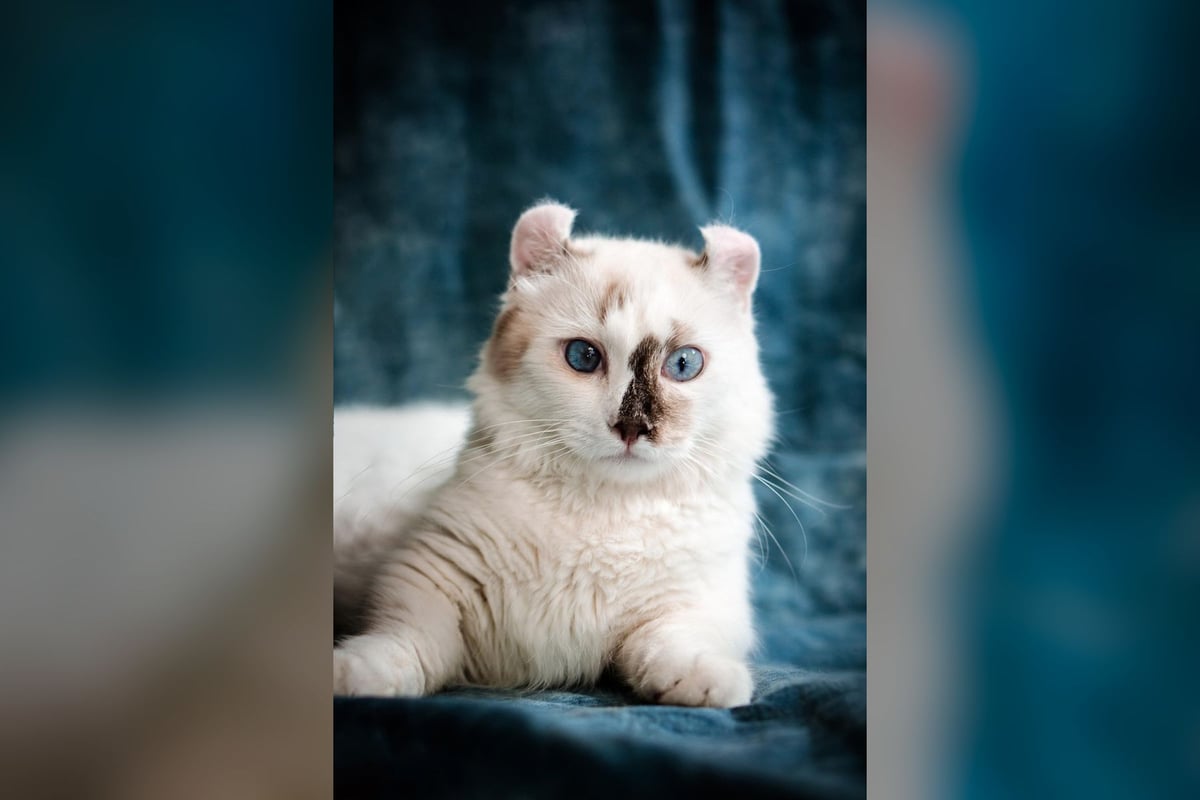
American Curl
The American Curl was born in 1981 in Lakewood, California, from a stray female cat named Shulamith whose ears curled spontaneously backward — an autosomal dominant mutation of the Cu gene, with no effect on the skeleton or on any other cartilage. Available in two variants (longhair and shorthair), it is characterized by a playful temperament that persists into old age, marked sociability and genetic robustness thanks to its diverse founding base. Recognized by LOOF, the CFA (1991) and FIFe (2002).
- Weight
- 3 to 5kg
- Height
- 23 to 33cm
- Life expectancy
- 14years
- Monthly cost
- 50 to 90€
Personality profile
Energy 4/5
Independence 3/5
Trainability 4/5
Good with children 4/5
Talkativeness 2/5
Space needed 3/5
Attachment to home 4/5
Good with strangers 4/5
Good with cats 4/5
Good with dogs 4/5
Coat care 3/5
Exercise needs 3/5
Scores given on measured axes, data confidence: high.
Living with an American Curl
Description
The silhouette is medium-sized, fitting within a semi-foreign rectangle: a slightly elongated body (roughly 1.5 times the shoulder height in length), moderate musculature, and a build that is neither heavy nor fine-boned. The head is a modified wedge with no flat planes, and a slightly curved profile; the nose is straight, the cheekbones are not prominent, and the chin is well-defined. The eyes, walnut-shaped (oval on top, round on the bottom), are set well apart and can be any color. The tail is supple and about the same length as the body. The coat, in the longhair variant, is semi-long, fine and silky in texture with minimal undercoat — less voluminous than the Maine Coon's or the Norwegian's, but full enough to give the coat some body. The shorthair variant has a short, smooth coat with a slightly resilient feel. All genetically possible colors and patterns are accepted (solid, classic tabby, mackerel, spotted, ticked, colorpoint, bicolor, calico, smoke). Adult weight is between 3 and 5 kg depending on sex. The defining feature is the ear: the pinna curls back toward the back of the head in an open arc, its tip pointing toward the nape. The CFA standard requires a minimum arc of 90° and firm cartilage over at least the first third of the ear's height; degrees 2 (moderate arc) and 3 (crescent arc) are the ones shown in competition. At both LOOF and the CFA, the two coat variants are registered separately — longhair (ACL) and shorthair (ACS).

Temperament
Breeders talk of a "Peter Pan cat": its level of playfulness and curiosity does not decline with age, unlike most domestic breeds, which settle into a more sedentary profile after 3-4 years. It follows its owners from room to room, readily joins in daily activities and shows sustained attention to everything happening around it. Its vocalizing is discreet — a few chirps rather than repeated meowing — which contrasts with its bodily and auricular expressiveness. It cohabits without notable friction with children, other cats and properly introduced dogs. Its trust toward strangers builds quickly and unconditionally: it readily approaches visitors after a few minutes of observation. Its attachment to people is solid without being possessive; it tolerates normal-length absences well provided it has enough stimulation.
Training
Positive reinforcement works well here, driven by natural curiosity and motivation through play and rewards. Its energy level and sustained attention make learning simple tricks easy — giving a paw, clearing an obstacle, answering to its name — in short sessions of 5 to 10 minutes repeated daily. Clicker training gives good results with this breed: the precision of the signal matches its attentive way of processing stimuli. Regular mental and physical activity is essential to its balance — an understimulated cat quickly develops unwanted exploratory behaviors (opening cupboards, moving objects). The method must rely exclusively on positive reinforcement; physical restraint is counterproductive and damages the relationship of trust.

Feeding
An adult needs a balanced diet suited to its medium build and sustained activity level. For an active 4 kg adult, a ration of 200 to 240 kcal a day split into two meals is a reasonable baseline, to be adjusted for individual metabolism and neuter status. Favor premium kibble high in animal protein (> 30%) and low in carbohydrates. Partial wet feeding (every other meal) supports hydration and can help prevent urinary stones. For kittens, a dedicated kitten diet up to 12 months; growth is moderate and completes before age 1, without the slow-maturing specifics of large breeds.
Affiliate links, no extra cost to you. Legal notice

Living conditions
Apartment life goes well provided its energy level is accounted for: it needs daily activity sessions, interactive toys and climbing structures to occupy its mind. A cat tree of at least 150 cm, hideaways, food puzzles and regular play sessions are prerequisites rather than options. A home of 40 m² or more is enough if these arrangements are in place. The breed copes well with normal indoor temperatures; it is not particularly sensitive to cold or moderate heat, but like any semi-longhair cat, prolonged exposure to heatwaves should be avoided. A secure balcony is a welcome enrichment. Exclusively indoor living is recommended to prevent ear injuries (delicate cartilage, an accidental target) and infectious disease.

Grooming and coat care
Grooming the longhair variant is moderate: the semi-long coat, fine and with little undercoat, tangles less easily than a Persian's or a Ragdoll's. Regular brushing, two to three times a week with a fine metal comb, is enough in routine; during seasonal molts (spring, fall), step it up for two to three weeks to limit hair ingestion and hairballs. The shorthair variant needs only a pass with a glove or soft brush once a week. Ear cleaning deserves particular attention: the curled structure can trap wax in the outer canal; clean weekly with an appropriate veterinary product, without inserting a cotton swab into the canal, and handling the pinna without forcing the cartilage. Never try to straighten the ears: once the cartilage sets at 16 weeks, it is rigid, and any pressure can cause a fracture.

Health
The health profile is remarkably favorable for a recently created breed. The mutation responsible for the curled ears is carried on the Cu gene, with autosomal dominant inheritance. Geneticist Roy Robinson established as early as 1989 that this mutation affects only ear cartilage and produces no systemic bone or cartilage consequences — a fundamental difference from the Fd gene in the Scottish Fold, whose FGFR3 mutation causes a documented osteochondrodysplasia (OCD) affecting the entire skeleton. Most cats from serious breeding programs are Cu/cu heterozygotes; no form of OCD is associated with this genotype in the veterinary literature. The breed's broad founding base — the CFA allowed outcrossing with non-pedigree domestic cats until 2015 — has maintained high genetic diversity, reducing the risk of accumulating harmful recessive mutations seen in highly inbred breeds. No breed-specific genetic disease is documented to date. Standard annual veterinary checkups remain recommended, as for any companion cat. Special attention should be paid to the ears: the characteristic firm cartilage makes them potentially vulnerable to trauma from rough handling — never force the fold or try to straighten the ear. Observed life expectancy is 12 to 16 years, with a median around 14 years in well-monitored populations.
Breed history
The story of the American Curl begins in June 1981 in Lakewood, Los Angeles County, California. Grace and Joe Ruga took in a stray black longhaired female cat whose ears showed a spontaneous backward curl — a form never documented in the feline literature of the time. The cat, named Shulamith (after the beloved of the Song of Songs), gave birth to a first litter in which two kittens out of four inherited the curled ears, empirically confirming the dominant transmission of the mutation even before its genetic basis was formalized. Geneticist Roy Robinson published an analysis in 1989 concluding that this was an autosomal dominant mutation of the Cu gene, with no consequences for the skeleton or for any cartilage other than the ears — a critical distinction from the Fd gene in the Scottish Fold, already criticized at the time for the bone problems it causes. TICA recognized the breed as early as 1985 for the longhair variant, then 1986 for the shorthair — a record recognition speed attributed to the clarity of the genetic profile and the absence of any documented health problem. The CFA granted recognition in 1991, FIFe in 2002. The two variants (longhair ACL and shorthair ACS) are registered separately in most registries, including LOOF. A notable feature of the breeding policy: the CFA kept permission to outcross the breed with non-pedigree domestic cats until 2015 to preserve the breed's genetic diversity — a rare practice in the pedigree cat world, but justified by the fact that the breed descends from a single founder, and widening the gene pool prevented the accumulation of recessive defects.
Getting ready for your American Curl
Four essentials to line up before day one.
Affiliate links, no extra cost to you. Legal notice
FAQ: American Curl
Sources
- Wikipedia FR — American Curl · Origin: Shulamith, a stray female cat, Lakewood California 1981, owners Grace and Joe Ruga. Autosomal dominant mutation of the Cu gene, no health consequences (Roy Robinson 1989). Two variants, shorthair (ACS) and longhair (ACL). Weight 3-5 kg, life expectancy 12-16 years. Recognition: TICA 1985, CFA 1991, FIFe 2002.
- CFA — American Curl Breed Standard · CFA standard: semi-foreign body, length 1.5× height. Ears: 90-180° arc, firm cartilage over 1/3 of the height. Kittens' ears are straight at birth, curl sets at 16 weeks. Two divisions (longhair/shorthair). All colors accepted. No breed-specific health problem documented. Outcrossing with domestic cats permitted until 2015.
- LOOF — Recognized cat breeds · The American Curl is among the breeds officially recognized by the Livre Officiel des Origines Félines. The longhair and shorthair variants are registered under separate codes.

