


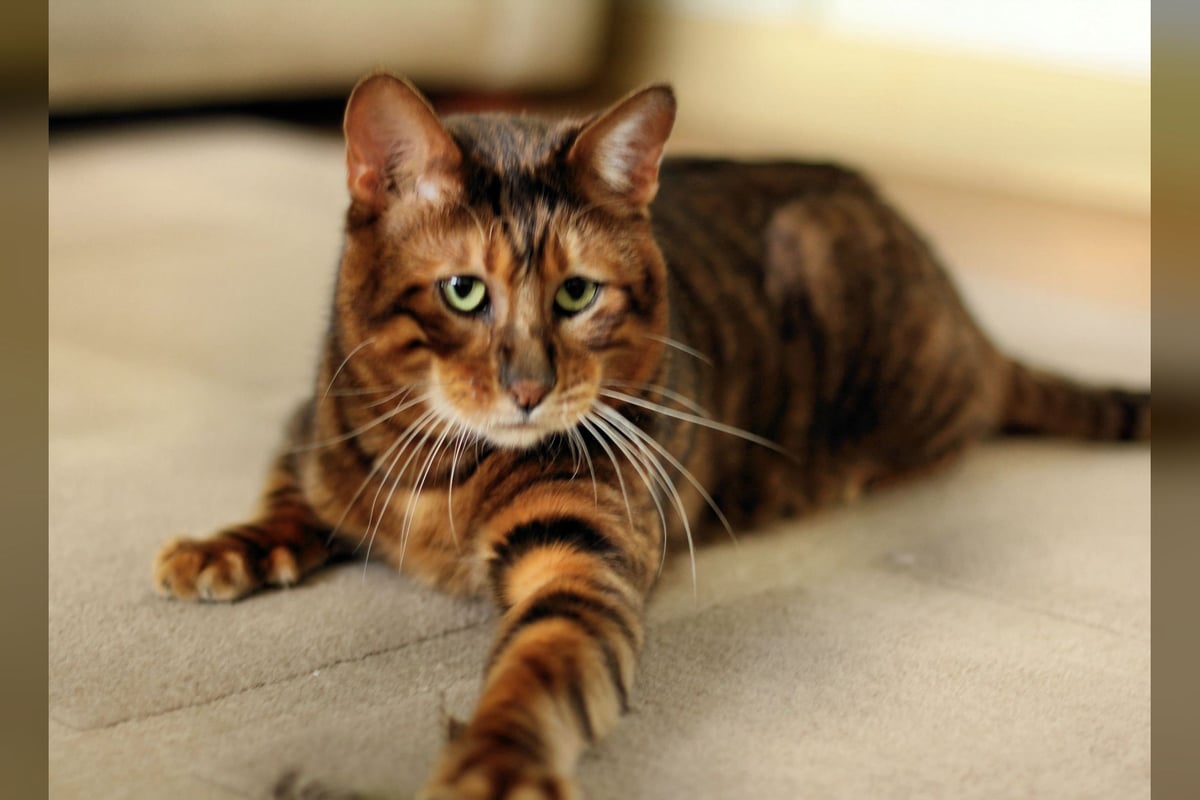
Toyger
The Toyger is an American breed born in the 1980s at the initiative of Judy Sugden — daughter of Jean Mill, the creator of the Bengal — with the ambition of reproducing the Bengal tiger's vertical striped pattern in miniature. Recognized for championship status by TICA in 2007, it remains one of the rarest breeds in the world, with roughly thirty active breeders recorded. Its brown mackerel tabby coat, with intense vertical stripes on a bright orange background, sets it apart from every other domestic cat.
- Weight
- 4 to 7kg
- Height
- 25 to 35cm
- Life expectancy
- 12years
- Monthly cost
- 70 to 120€
Personality profile
Energy 4/5
Independence 3/5
Trainability 4/5
Good with children 4/5
Talkativeness 3/5
Space needed 4/5
Attachment to home 4/5
Good with strangers 3/5
Good with cats 4/5
Good with dogs 4/5
Coat care 1/5
Exercise needs 4/5
Scores given on measured axes, data confidence: medium.
Living with a Toyger
Description
The build is semi-foreign, medium-sized, muscular and elongated, with a low shoulder gait deliberately reminiscent of the wild tiger. The head is medium in length, rounded, with a pronounced chin; the ears are small, round, placed equidistant between the top of the skull and the sides, ideally fringed with small tufts mimicking the white spots on a tiger's ears. The eyes are round to slightly almond-shaped, with a subtle oblique angle, in a golden to deep green background color. The neck is long and muscular. The tail is very long, thick at the base, carried low like a tiger on the move. The coat is short, dense and silky, with guard hairs sometimes longer on the body that heighten the depth of contrast. The coat admits only one pattern: brown mackerel tabby. The stripes are vertical on the body, contrasted and well defined on a golden orange background, while the face shows circular markings mimicking the tiger's facial rosette. The belly, chin and cheeks show characteristic pale patches. Adult weight ranges from 4 to 7 kg, with males at the top of the range. A slow-maturing breed, reaching adult size around 2-3 years.

Temperament
An attentive, sociable cat, closely bonded to its owner, it happily follows them from room to room without being intrusive. Its intelligence, inherited from the Bengal, shows up as active curiosity and a marked aptitude for interactive play. It seeks human interaction and quickly gets bored without stimulation, though without reaching the hyperactivity level of the purebred Bengal. Its vocalizing is moderate: it communicates through soft meows and trills, without the Bengal's outbursts. It cohabits without difficulty with children and other properly introduced animals. The breed is described as calmer than its Bengal ancestor while retaining its predator's curiosity: it observes, plans and acts with a method reminiscent of the big cat whose pattern it carries.
Training
It inherits the Bengal's operational intelligence and responds very well to clicker training. Giving a paw, retrieving a toy, going through a tunnel, following a target: all of this can be learned, provided the sessions stay short (5-10 minutes), varied and end on a success. Motivation comes mainly through play and food rewards; physical coercion is to be avoided, as with every breed descended from Bengal lines. Harness walking is achievable with gradual training starting from kittenhood, even though the breed is rarer on this point than the Bengal. Cognitive stimulation is a need, not a luxury: understimulated, it develops redirected behaviors.

Feeding
An active cat with a sustained metabolism, it needs a diet rich in animal protein. For a 5 kg adult, plan on 250-320 kcal/day depending on activity level. Favor premium kibble high in animal protein (≥38%) and low in carbohydrates, ideally supplemented with a portion of quality wet food. Given the potential HCM predisposition inherited from the Bengal, an adequate taurine intake is relevant. Splitting into 2-3 meals a day, ideally through puzzle feeders, stimulates the hunting instinct and prevents rapid ingestion. The breed isn't particularly prone to obesity, but weight monitoring is called for in neutered, under-stimulated individuals.
Affiliate links, no extra cost to you. Legal notice

Living conditions
It adapts to an apartment provided the environment is enriched, and is ideally suited to a house with a secure garden: vertical structures (a cat tree ≥ 1.80 m, wall shelves), hiding spots, hunting toys refreshed on rotation, and at least 30 to 45 minutes of interactive play a day. A studio with no explorable floor space is not advisable for it. Its low gait and tactile curiosity call for explorable floor space rather than a single perch. Access to a secure outdoor area (catio, netted balcony) is a real plus. The breed handles cold moderately well — its short coat with no dense undercoat gives it little thermal insulation — and tolerates heat well thanks to its moderate muscle mass. Strictly indoor living is recommended for a breed this rare and sought-after, provided rigorous behavioral enrichment is in place.

Grooming and coat care
The short, close-lying coat is among the simplest to maintain within the distinctive-coat breeds. A weekly brushing with a grooming glove is enough under normal conditions to remove dead hair and keep the tabby contrast vivid. Molting is moderate, with no pronounced seasonal peak for an indoor cat. No regular bathing is needed. Watch the ears and clean gently if wax builds up. Claws need trimming roughly every three weeks, as the breed is active and highly demanding of vertical structures.

Health
A young breed still in genetic stabilization, it rests on a very narrow worldwide breeding pool (roughly thirty active breeders). No hereditary condition specific to the breed is documented to date in the veterinary literature. However, the Bengal's presence among the founders calls for vigilance on two fronts: hypertrophic cardiomyopathy (HCM), reported in the Bengal, which should be screened by annual echocardiogram from age 2 in breeding cats; and progressive retinal atrophy (PRA), present in certain Bengal lines, testable by DNA. The founding pool's low genetic diversity is the breed's structural health risk: demanding documented pedigrees and full genetic testing on both parents remains an unavoidable precaution. The breed is not hypoallergenic.
Breed history
The Toyger was conceived by Judy Sugden in the early 1980s, carrying on her mother Jean Mill's work on the Bengal. Observing unusual circular markings on the temples of one of her domestic cats, she had the insight that the Bengal tiger's (Panthera tigris tigris) striped pattern — dense vertical mackerel stripes on an orange background — could be reproduced in an entirely domestic cat, with no hybridization with a wild felid. Selection crossed tabbies with pronounced vertical stripes with Bengals to increase color contrast and saturation. An Indian street cat carrying comparable facial markings was imported to enrich the program's genetic diversity. TICA registered the breed for evaluation in 1990 and granted it championship status in 2007, with the WCF recognizing it the same year. The French LOOF added it to its registry in 2016. The breed remains scarce: roughly thirty active breeders worldwide in 2024, with an acquisition price between 2 000 and 5 000 € depending on the line and country.
Getting ready for your Toyger
Four essentials to line up before day one.
Affiliate links, no extra cost to you. Legal notice
FAQ: Toyger
Sources
- Wikipedia FR — Toyger · Breed created by Judy Sugden in the 1980s. TICA registration 1990, championship 2007. WCF 2007, LOOF 2016. Only permitted coat: brown mackerel tabby. Foundation: domestic tabbies and Bengals.
- Wikipedia EN — Toyger · About 30 active breeders worldwide in 2024. Kitten prices up to $5 000 (2020). 469 Toygers registered in the Pawpeds database in 2020. Breed designed to raise awareness of tiger conservation.
- TICA — Toyger Breed Standard · Championship recognition by TICA 2007. Standard: muscular semi-foreign silhouette, vertical mackerel stripes, rounded head, small ears, low gait evocative of the tiger.

